
Berlin gets fast and focused here.
This cruise-port day trip strings together top landmarks without making you figure out public transit, and I especially like the way it pairs the Reichstag exterior with the Brandenburg Gate for a clean first-timer route. You also get a serious, reflective arc later with WWII and Holocaust sites, not just pretty buildings. One thing to watch: it’s built for a cruise schedule, so most stops are short and you’ll move at a steady clip.
The real win is logistics. Pickup and drop-off from Warnemünde are handled with air-conditioned transport, and they stress a guaranteed return to your ship on time. You won’t get a leisurely stroll through every museum, but you will get a well-shaped day that covers a lot of Berlin in the right order—historically and geographically.
In This Review
- Key Things That Make This Berlin Day Trip Work
- Cruise-Port Pickup and the Real Meaning of a 10-Hour Day in Berlin
- Charlottenburg Palace for Quick Baroque and Rococo Impressions
- Ku’damm and Siegessäule Drive-By Stops That Still Matter
- The Reichstag and Brandenburg Gate: Where the Story Turns to Democracy
- Holocaust Memorial: A Hard Stop, Done the Right Amount
- Führerbunker Area and Lunch Break: Reflection Plus a Scheduled Reset
- Alexanderplatz, Museum Island, and Bebelplatz: Berlin’s Layers in Three Stops
- Checkpoint Charlie and Topography of Terror: Cold War Reality, Not Just Photos
- Transportation Comfort, English Guidance, and the Group Pace
- Price and Value: Why $211 Can Be a Smart Cruise Choice
- Who This Berlin Tour Best Fits (and Who Should Pass)
- Should You Book This Berlin Excursion?
- FAQ
- How long is the Berlin tour from the cruise port?
- Where do I meet the tour?
- How long is the coach ride to Berlin?
- Is the tour guided in English?
- Which stops include guided time?
- Is food included in the price?
- Will the tour get me back to the ship on time?
- Is the tour wheelchair accessible?
- Can I cancel for a full refund?
Key Things That Make This Berlin Day Trip Work
- Cruise-friendly timing with coordinated pickup and a guaranteed return window
- A strong “West to East” flow from Charlottenburg vibes to Cold War corners
- Big photo icons with guided context at the Reichstag and Brandenburg Gate
- WWII weight in real places: Holocaust Memorial and the Führerbunker area
- Cold War landmarks in one sweep: Checkpoint Charlie plus Topography of Terror
More time out on the Spree
- Berlin: Boat Tour Along the River Spree★ 4.4 · 11,252 reviews
- Berlin: 1-hr Boat Tour with Bilingual Live Guide (DE/EN)★ 4.7 · 5,653 reviews
- Berlin: 3.25-Hour Spree & Landwehrkanal Boat Tour★ 4.6 · 4,311 reviews
- Berlin: 1-Hour City Sightseeing Cruise★ 4.4 · 2,210 reviews
Cruise-Port Pickup and the Real Meaning of a 10-Hour Day in Berlin
This is a 10-hour tour built around the reality of cruise days: you want maximum Berlin, with minimum stress. You meet at the Warnemünde Cruise Center holding a sign that reads J A T. Then you climb onto a modern, air-conditioned coach for the long, scenic transfer—about 3 hours toward Berlin and about 3 hours back.
That timing matters. In Berlin, distances are manageable but not instant, and figuring out trains with luggage, crowds, and changing lines can eat your whole day. Here, your transportation is handled, and the operator emphasizes that you’ll be returned to your ship on time. That doesn’t eliminate all stress, but it removes the big one.
You’ll also want to be mentally ready for a “see, learn, move” format. Many stops include a guided segment plus a photo stop, but you won’t have hours to wander. If you like long museum hours or slow café time, consider it less of a flexible city day and more of a curated highlights circuit.
Charlottenburg Palace for Quick Baroque and Rococo Impressions
Your first major Berlin stop is Charlottenburg Palace. You’ll get a photo stop plus a guided tour for about 30 minutes. Even with limited time, this is a smart start because it sets a “Berlin has layers” tone immediately, before you jump into 20th-century history.
What makes this stop useful for you is variety. Charlottenburg Palace isn’t one of those places where you only understand it if you already know the art-history story. In a short visit, the goal is recognition: the exterior style, the grand feel, and the sense of a different era of power and taste.
Practical tip: treat this like a warm-up. If you’re tempted to chase every angle for the perfect photo, you might slow down the group. Aim for one or two strong views, then let the guide’s quick context do the rest.
Ku’damm and Siegessäule Drive-By Stops That Still Matter
After Charlottenburg, you’ll pass by Kurfürstendamm (Ku’damm), Berlin’s famous shopping-and-street-life corridor. This is one of those places you don’t need to stop for to understand Berlin’s everyday rhythm. Even from a coach window, you get a sense of scale and modern city energy.
Next comes the Berlin Victory Column, or Siegessäule, also a pass-by. It’s topped with the golden statue of Victoria and ties into Prussian military history. From a tour perspective, why include it? It’s a visual bridge between different eras of Berlin identity—imperial to democratic to post-war.
These drive-bys are short. So, if you want photos, be ready. Don’t count on extra time once the coach moves again.
The Reichstag and Brandenburg Gate: Where the Story Turns to Democracy
The Reichstag Building is one of your first “big meaning” stops. You get a photo stop and a guided look for about 15 minutes focused on the façade of the building that houses the German Bundestag (Parliament). This is a stop built for understanding: you’re looking at the exterior, but the guide context helps you connect architecture to government and modern Germany.
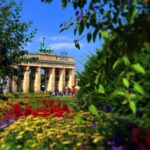
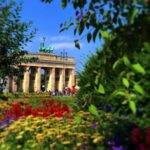
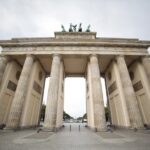
Then you move to the Brandenburg Gate. This is photo stop plus guided time of about 10 minutes. It’s also one of those landmarks that everyone recognizes instantly, but the value comes from what you learn while standing in front of it: built between 1788 and 1791 as a city gate, it became a symbol of Germany’s unity and historical meaning.
The best way to enjoy this pair is to think of it as an “identity shift” moment. Start with the parliament façade, then turn toward the Gate. You’ll feel how Berlin can be both ceremonial and political at the same time.
More Berlin day trips from the Warnemünde pier

Holocaust Memorial: A Hard Stop, Done the Right Amount
The Holocaust Memorial is included with a photo stop and a guided visit of about 15 minutes. The memorial is designed by Peter Eisenman and includes 2,711 concrete slabs spread across a large expanse. You’re not meant to treat this like a quick sightseeing checkbox.
In a short time, the guide’s role is important. You won’t get long, silent wandering, but you will get structure: what it is, why it looks the way it does, and what it represents. For you, the practical aim is to slow down for a moment inside the group’s pace.
If you’re the type who needs time to process, don’t try to “out-think” the emotion. Stand where you feel it. Even with limited minutes, you’ll still get the message.
Führerbunker Area and Lunch Break: Reflection Plus a Scheduled Reset
After the Holocaust Memorial, you’ll take a break in the day’s rhythm with a stop at Hitler’s bunker site, the Führerbunker. The plan includes a brief walk and photo stop, plus a guided segment. The total block is about 1 hour and includes time for a lunch break.
This is not a casual lunch-and-photo moment. It’s a conclusion of Adolf Hitler’s regime in Berlin’s historical narrative, and the route handles it as such. You’ll also get help locating places with convenient dining options and restroom facilities, which is a big deal on a cruise day where you don’t want to hunt for basics.
For you, the smart move is to eat earlier rather than later during the lunch segment. The group will want to keep moving, and it’s easier to enjoy the meal if you’re not sprinting back to the coach at the end.
Alexanderplatz, Museum Island, and Bebelplatz: Berlin’s Layers in Three Stops
Next you pass by Alexanderplatz, a central square where you’ll spot features like the World Clock and the Fernsehturm (TV Tower). Pass-by stops can feel like speed-reading, but Alexanderplatz works because it gives you a modern Berlin anchor point. It’s a quick way to reset your brain after the heavier sites.
Then comes Museum Island, recognized as a UNESCO World Heritage Site. You’ll have a guided visit for about 15 minutes, with attention on key architecture in the area, including the Berlin Cathedral and the Old Museum. Even in a short visit, this is valuable because it gives you a map for later. After this tour, you’ll know where to look if you ever return for longer museum time.
Finally, you visit Bebelplatz with about 10 minutes of guided time. It’s historically known as the site of Nazi book burnings in 1933. Again, it’s not a long stay, but it’s a meaningful one—one of those places where the guide can connect political ideology to cultural harm.
If you’re trying to absorb everything, don’t force it. Pick one of the three and focus your attention. You’ll remember the “shape” of the day more clearly than if you try to memorize every detail.
Checkpoint Charlie and Topography of Terror: Cold War Reality, Not Just Photos
Checkpoint Charlie is next, with about 20 minutes of guided time. It’s the well-known crossing point between East and West Berlin during the Cold War. The tour frames it as a hub for spies and a location that saw tank confrontations in 1961. This is a solid stop for you if you like history you can point to. It’s a defined place, not just an abstract era.
Your final destination is Topography of Terror. This stop includes a photo stop and about 15 minutes with a guide. Here you confront the somber history of Nazi Germany through the former headquarters of the SS and Gestapo, plus a chance to contemplate the enduring effects of the Berlin Wall.
Why this ending works: it closes the loop from earlier “Germany in symbols” moments to the lived consequences of ideology and power. Also, ending with Topography of Terror keeps the emotional weight from getting watered down by a random shopping stop.
Transportation Comfort, English Guidance, and the Group Pace
The tour runs with modern air-conditioned transportation and a certified English-speaking guide in Berlin. That combination matters because you’re on a coach for hours, and you don’t want the “guide time” to be wasted with unclear explanations.
Pace is the trade-off. The day includes several guided stops, but each is timed, so you won’t linger. That’s why this suits cruisers well and why it might not suit people who want to drift.
From the experience style, the day is meant to be smooth: getting to each stop on schedule, keeping the group together, and making sure the ship return isn’t a gamble. In past cruise-focused days, the most appreciated part tends to be that organization—getting back when they say you will.
One more practical note for you: the tour isn’t wheelchair accessible, and it’s not suitable for people with mobility impairments. Strollers are allowed, and infants must sit on laps. If mobility is a concern, you’ll want to choose a different Berlin option with easier logistics.
Price and Value: Why $211 Can Be a Smart Cruise Choice
At $211 per person for a 10-hour day, the price is really about convenience plus guided value. You’re paying for round-trip pickup and drop-off from the cruise port, a full day of transport, and a certified English-speaking guide covering major sites that would otherwise take real planning time.
Two big cost-saving angles for you:
- You avoid the time tax of figuring out transit from a cruise port location and coordinating timing back to ship departure.
- You get contextual guidance at stops that otherwise can feel like photo backdrops.
What’s not included is food and beverages. You will have a lunch break, and your guide can help you find places with convenient dining and restroom options, but you’ll still handle your own meal costs.
So here’s the balanced way to judge value: if you want a guided highlights route with minimal logistical friction, the price can feel fair. If you’re a slow traveler who wants deep museum time and lots of flexibility, you might feel restricted by the fixed schedule.
Who This Berlin Tour Best Fits (and Who Should Pass)
This is a great fit for:
- Cruise passengers with limited time in Berlin
- First-timers who want the “greatest hits” plus real historical context
- People who prefer guided structure over independent planning
- History-minded visitors who don’t want to piece together multiple neighborhoods
It’s a weaker fit if:
- You need wheelchair access or have mobility limitations
- You want long, unscheduled time at each stop
- You get stressed by tight schedules and moving as a group
Should You Book This Berlin Excursion?
If your cruise day in Warnemünde gives you one shot at Berlin, I think this is a solid choice. It’s structured, coach-based, and designed to cover key Berlin landmarks and heavy history in a way that’s realistic for a cruise schedule. You’ll trade time for breadth, but you’ll come away with a clear map of what to revisit later.
Book it if you like guided storytelling and want the confidence that you’ll be back at your ship on time. Skip it if you’d rather build your own day at a slower pace or if mobility needs make fast pacing unrealistic.
FAQ
How long is the Berlin tour from the cruise port?
The total duration is 10 hours.
Where do I meet the tour?
You meet at the Warnemünde Cruise Center and hold a sign that reads J A T.
How long is the coach ride to Berlin?
The coach ride is listed as 3 hours to Berlin.
Is the tour guided in English?
Yes. The tour includes a certified English-speaking guide.
Which stops include guided time?
Charlottenburg Palace, the Reichstag, Brandenburg Gate, the Holocaust Memorial, the Hitler’s Bunker site area, Museum Island, Bebelplatz, Checkpoint Charlie, and Topography of Terror all include guided time. Some other locations are pass-by stops.
Is food included in the price?
No. Food and beverages are not included. There is a lunch break during the Hitler’s bunker site portion, and the guide can help you find dining and restroom options.
Will the tour get me back to the ship on time?
Yes. Pickup and drop-off from the cruise port include a guaranteed return to your ship on time.
Is the tour wheelchair accessible?
No. It is not wheelchair accessible and is not suitable for people with mobility impairments.
Can I cancel for a full refund?
You can cancel up to 24 hours in advance for a full refund.
More Tour Reviews in Berlin


Berlin From the Warnemünde Pier
More Hours on the Spree

Round out your days in Berlin
Spree River Cruises, compared.
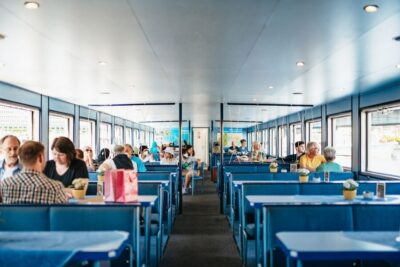 ★ 4.31-Hour City Tour by Boat with Guaranteed SeatingFrom $2516,993 reviews
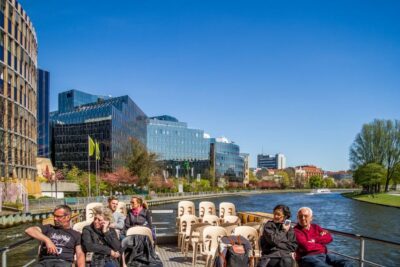 ★ 4.4Boat Tour Along the River SpreeFrom $3411,252 reviews
 ★ 4.71-hr Boat Tour with Bilingual Live Guide (DE/EN)From $225,653 reviews
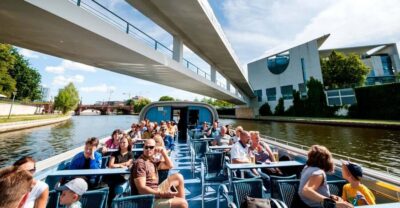 ★ 4.63.25-Hour Spree & Landwehrkanal Boat TourFrom $384,311 reviews
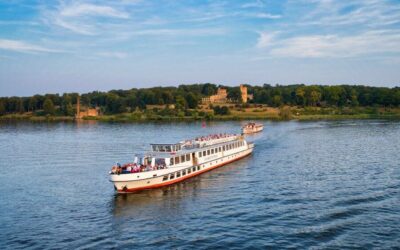 ★ 4.5Potsdam: Palace Tour by BoatFrom $272,369 reviews
 ★ 4.41-Hour City Sightseeing CruiseFrom $252,210 reviews
 ★ 4.42.5-Hour East Side Boat Cruise with CommentaryFrom $352,016 reviews
 ★ 4.6Spree Boat Tour to MüggelseeFrom $251,973 reviews
Browse the lists this tour appears in