
REVIEW · THIRD REICH & WWII HISTORY
Berlin Jewish Quarter and Holocaust History Walking Tour
Berlin remembers, and this walk teaches. You start at the Memorial to the Murdered Jews of Europe, then move through the Old Jewish Quarter where history is marked right in the streets with Stolpersteine. I like that the tour doesn’t treat memorials like checkboxes; it connects what you see to the people who lived, were persecuted, and were deported.
I also like the payoff of the longer options, especially the chance to visit the New Synagogue and, on the 5-hour route, the Jewish Cemetery at Schönhauser Allee. One heads-up: this is a walking tour (about 3.5 km), and it includes heavy Holocaust material, so wear comfortable shoes and bring your focus.
In This Review
- What Makes This Berlin Jewish Quarter Tour Worth Your Time
- Key Stops You’ll Actually Remember
- Starting at Pariser Platz: The Walk’s Emotional Reset Button
- Memorial to the Murdered Jews of Europe and Trains to Life – Trains to Death
- Old Jewish Quarter Traces: Stolpersteine and What They Mean
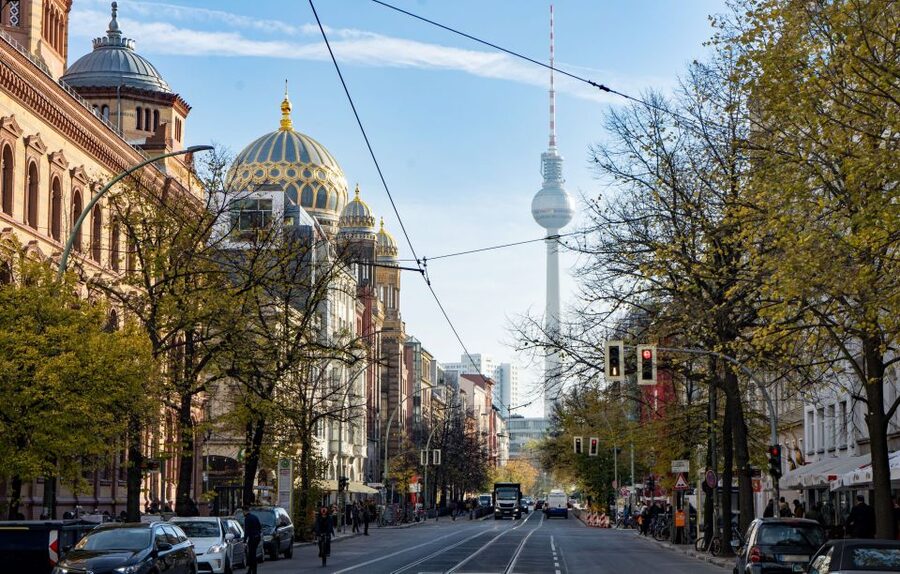
- The New Synagogue: Moorish Revival Beauty With Real History
- Hackesche Höfe: Courtyards That Explain How the City Worked
- Jewish Cemetery at Schönhauser Allee: Names You Can Pronounce
- How the 3 vs 4 vs 5 Hours Changes the Value
- Price and What You’re Paying For
- Practical Tips That Make This Walk Easier (and Better)
- Who This Tour Suits Best
- Should You Book This Berlin Jewish Quarter and Holocaust History Walk?
- FAQ
- How long is the Berlin Jewish Quarter and Holocaust History Walking Tour?
- Is this a private tour?
- Where do I meet the guide?
- What does the tour include regarding the New Synagogue and the Jewish Cemetery?
- Is the New Synagogue included in the 3-hour tour?
- Are there any closures I should plan around?
- Can I visit the dome of the New Synagogue?
- How much walking is involved?
- What languages are available for the live guide?
- Is there free cancellation and is payment required right away?
What Makes This Berlin Jewish Quarter Tour Worth Your Time
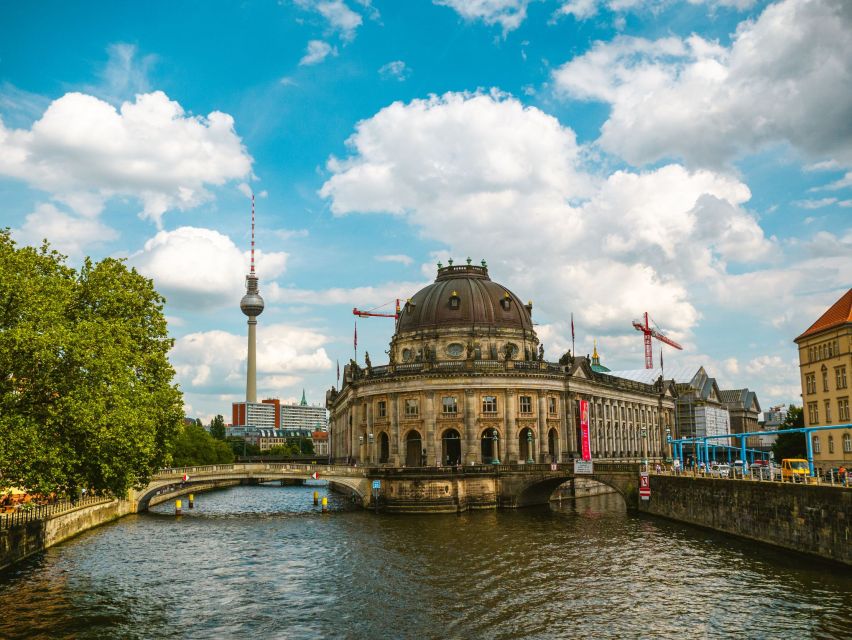
This is the kind of Berlin walk that gives you context fast—and then keeps it real. The guide leads you through key reminders of Jewish life across centuries, but the tone stays grounded: you’re not just sightseeing, you’re learning how neighborhoods changed, how people were erased, and how memory survives.
The structure is smart, too. You begin at a major Holocaust memorial, so you understand the stakes before you’re suddenly staring at street-level traces like Stolpersteine. Then you move into the area that once held a thriving community, including places tied to prayer, public life, and burial grounds.
A final reason I think this works for a lot of people: it’s private. You’re not competing with other groups for the guide’s attention, and you can ask follow-up questions as the story builds. In the guide feedback I saw, one name kept coming up—Karen—highlighted for being professional, patient, and careful with facts and people.
More walks through Berlin's wartime history
- Berlin: Third Reich & Cold War Guided Walking Tour★ 4.9 · 8,378 reviews
- Berlin’s Best: 2 Hour Walking Tour Third Reich and the Cold War★ 5.0 · 5,486 reviews
- Third Reich Berlin: Hitler and WWII Walking Tour★ 5.0 · 3,301 reviews
- Berlin: Third Reich, Hitler, and WWII Walking Tour★ 4.9 · 1,757 reviews
Key Stops You’ll Actually Remember
- Memorial to the Murdered Jews of Europe sets the tone before you walk into the streets and courtyards.
- Stolpersteine connect the Holocaust to specific addresses you can picture, not just vague history.
- Hackesche Höfe shows daily life before World War II through historic courtyards.
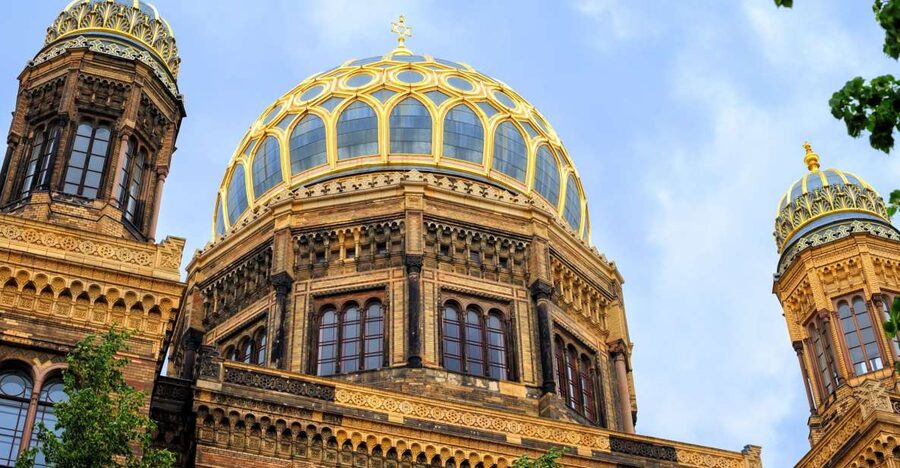
- The New Synagogue’s Moorish Revival design is still visible proof of a community that refused to disappear.
- The cemetery gives faces and names through tombs of well-known community members.
- Tour length changes what feels most complete (3 hours is solid; 4 and 5 add major sites).
Starting at Pariser Platz: The Walk’s Emotional Reset Button
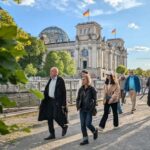
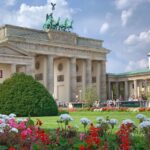
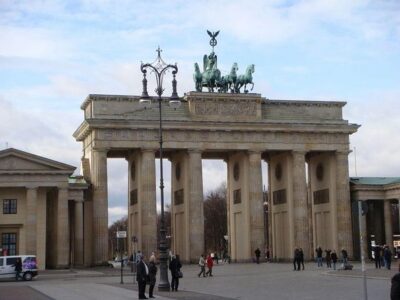
You’ll meet your guide outside DZ BANK AG at Pariser Platz 3. This matters more than it sounds. Pariser Platz is near the Brandenburg Gate area, and starting in that central, obvious public space helps you get your bearings before the story turns darker.
From here, the route leads you toward Berlin’s most recognizable Holocaust memorial starting point. The effect is simple: you’re not trudging into heavy topics blind. You get a handhold right away, and the guide frames what you’re about to experience.
It also helps that the tour is built for walking. You can’t do this well while rushing. You’ll want a calm pace and the mental space to read details—both on the ground and in the guide’s explanations.
Memorial to the Murdered Jews of Europe and Trains to Life – Trains to Death
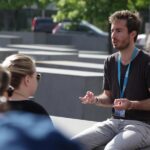
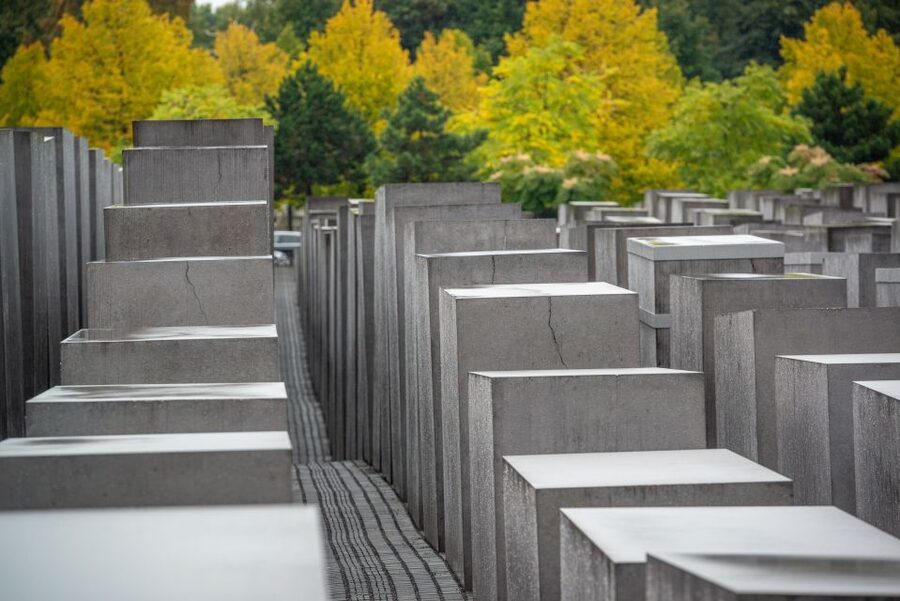
The tour’s opening stop is the Memorial to the Murdered Jews of Europe, which commemorates the 6 million Jewish victims of the Holocaust. If you’ve only skimmed Holocaust history before, this is where you slow down and start connecting dates to human loss.
A key piece of what you’ll likely learn here is how deportation is remembered through people-specific memorials. The tour includes discussion of children, too, via the Trains to Life – Trains to Death memorial. That’s the sort of detail that changes the entire feeling of the walk, because it stops you from treating history as a distant event.
Practical tip: give yourself time at the memorial. Don’t plan to take a quick photo and move on. You’re about to spend the rest of the tour thinking about what it means for a city to carry memory in public space.
Old Jewish Quarter Traces: Stolpersteine and What They Mean
As you head toward the former Jewish Quarter, you’ll see bronze Stolpersteine. These are small, street-level memorial stones placed in front of buildings, meant to commemorate individuals who lived nearby before they were murdered or deported.
Here’s why I like this part of the tour: it takes something huge and makes it local. You stop looking at Berlin as a backdrop and start treating it like a ledger of lives. The guide helps you read that ledger, explaining the historical context behind what you’re seeing.
You’ll also visit Hackesche Höfe, a complex of interlinked Jugendstil courtyards. That’s a helpful contrast. Holocaust memory is heavy, but the courtyards remind you that Jewish life in Berlin wasn’t only tragedy. It included neighborhoods, social space, and everyday movement. In a city that survived by rebuilding itself, these courtyard spaces give you a sense of scale—how close daily life was to whatever came next.
More of Berlin on foot


The New Synagogue: Moorish Revival Beauty With Real History

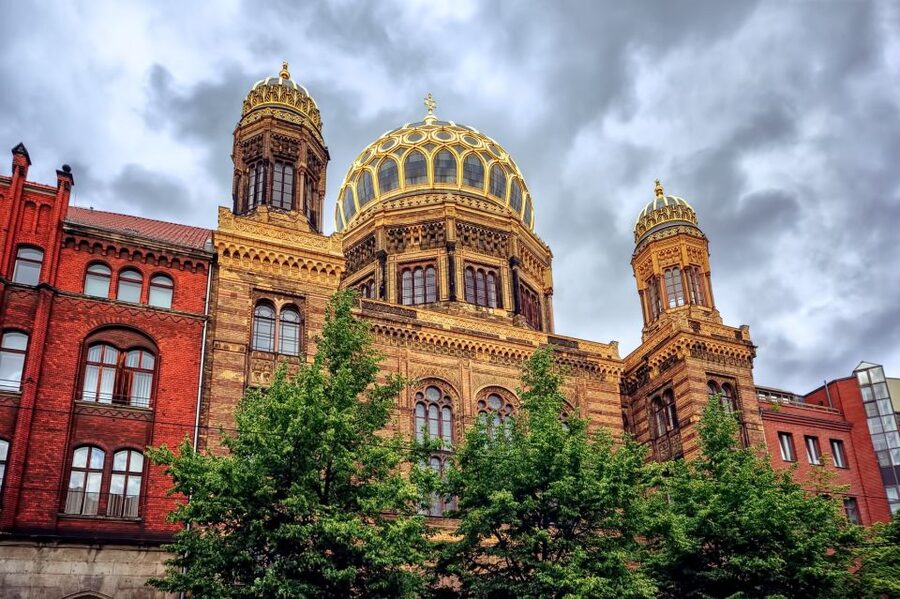
On the 4-hour and 5-hour options, you can visit the New Synagogue. It’s described as one of the few synagogues to survive Kristallnacht, which immediately explains why this building carries weight beyond architecture.
The synagogue is Moorish Revival, and the guide will show you both the interior and exterior. Since 1866, it’s been described as a center of Jewish life in Berlin, hosting prayers, concerts, and lectures—even during times when Jewish people were banned from other venues.
That combination is powerful. You’re not just looking at a religious building. You’re seeing a place that functioned as community infrastructure: a meeting point, a cultural venue, and a public symbol of endurance.
Important practical note: the synagogue and the Jewish Cemetery are closed on Saturdays and on the Jewish and German holidays. Also, the dome can only be visited from April to September. If the dome is a priority for you, plan your dates accordingly.
Hackesche Höfe: Courtyards That Explain How the City Worked
Hackesche Höfe isn’t just a pretty stop. It helps you visualize what the former Jewish Quarter felt like when people were living there, before the forced changes that followed.
The courtyards are interlinked and Jugendstil (Art Nouveau), so they give you angles—actual sightlines—into the idea of community space. When the guide explains daily life in Jewish Berlin before World War II, the architecture helps the story land. You can imagine going from street to courtyard, stepping into a more sheltered public area, and watching how the city held people together.
If you like “how things worked” more than “dates and names,” this is a great part of the tour. It’s easier to remember courtyards than it is to remember abstract timelines, and the guide uses that advantage.
Jewish Cemetery at Schönhauser Allee: Names You Can Pronounce
For the 5-hour tour only, you add the Jewish Cemetery at Schönhauser Allee. It’s described as the second oldest Jewish cemetery in Berlin, which matters because it signals long continuity—not just a single era.
This cemetery is also tied to Nazi desecration of an older burial ground, so the emotional tone is serious even before you read any names. The guide’s role here is especially important. A cemetery can become a blur if nobody tells you what to look for.
What makes it concrete: you’ll learn about notable community members buried there, including Max Liebermann, James Dimon, Gerson von Bleichröder, Solomon Haberland, and Giacomo Meyerbeer. Seeing names like these in a place of mourning gives you a different understanding of how broad Jewish influence was in Berlin’s cultural and economic life.
One practical plus: the cemetery has free entry on the 5-hour tour, so you’re not juggling extra fees once you’re there.
How the 3 vs 4 vs 5 Hours Changes the Value
All options share the big thread: old Jewish Berlin, key memorials, and the story of devastation and survival across time.
Here’s what changes with time:
- 3-hour option: Focuses on the strongest memorial start and the core street-level traces of the former Jewish Quarter, with major emphasis on the memorials and the Stolpersteine experience. Admission to the New Synagogue and the Jewish Cemetery is not included at this length.
- 4-hour option: Adds the New Synagogue visit (entrance fee included). This is where you get the architectural and cultural center of Jewish Berlin, not only the memory markers.
- 5-hour option: Adds the Jewish Cemetery at Schönhauser Allee (free entry) and deepens the personal aspect through notable names tied to the community.
If you’re choosing based on meaning, my advice is simple. If you want the full arc of Jewish memorial sites plus a major surviving synagogue, pick 4 hours. If you want the cemetery and the named people that make history feel more human, go 5.
If you’re short on time, the 3-hour option still sounds like a strong start because it begins at the Holocaust memorial and keeps the walk moving through the Jewish Quarter traces.
Price and What You’re Paying For
At $219 per person, this isn’t a cheap casual walk. The value comes from three things the tour is explicit about:
- A private guide: you get one group, not a crowd experience.
- Licensed, language-fluent expertise: the guide is described as 5-star licensed and fluent in your chosen language (English, French, German, Italian, Russian, or Spanish).
- Included access on the longer routes: New Synagogue entrance is included on 4- and 5-hour tours, and cemetery entry is free on the 5-hour tour.
So you’re not only paying for time in Berlin; you’re paying for interpretation—someone translating symbols (like Stolpersteine) into understandable, meaningful story.
If your budget is tight, you can save money by choosing the 3-hour route and adding the synagogue/cemetery on a separate day. But if you’d rather have the full story connected in one sequence, the longer options usually feel worth the extra cost.
Practical Tips That Make This Walk Easier (and Better)
- Wear comfortable shoes. The tour covers about 3.5 km, and you’ll stop often.
- Plan around closures. The New Synagogue and Jewish Cemetery are closed on Saturdays and on Jewish and German holidays.
- If you care about the dome: it’s only visitable from April to September.
- Bring mental stamina. This is Holocaust-focused. You’ll spend time at memorials, and it’s meant to be taken seriously.
- Use your guide language early. The tour runs in multiple languages; if you’re even slightly unsure, choose the language you feel most confident using for questions.
Also, one small but important habit: turn down the phone scrolling during memorial stops. Use the guide’s pacing and absorb the details they point out. That’s where the walk becomes more than information.
Who This Tour Suits Best
This experience fits you best if you want your Berlin history lessons to have structure. You’ll like it if you:
- want a clear story from medieval Jewish Berlin to the Third Reich and into remembrance today
- prefer walking through real city space rather than bus tours
- want personal context, including mention of children deported and remembered at Trains to Life – Trains to Death
- care about the surviving New Synagogue building and a cemetery visit for names and remembrance
It might be less suitable if you need a purely light sightseeing pace. Even though the tour is informative, the subject matter is heavy, and you should be ready for that tone.
Should You Book This Berlin Jewish Quarter and Holocaust History Walk?
Yes—if you want a guided, place-based understanding of Jewish Berlin and Holocaust memory, this tour is an efficient way to get it. The strongest reason to book is the order of experience: you begin at a major Holocaust memorial, then walk through street-level markers like Stolpersteine, then (on longer options) you visit the New Synagogue and the Jewish Cemetery with names tied to the community.
Choose 4 or 5 hours if the New Synagogue and cemetery access matter to you. Choose 3 hours if you’re time-limited but still want the memorial start and the core Old Jewish Quarter traces.
And if you’ve ever felt like Berlin’s history is too big to hold in your head, this kind of private walking tour helps you carry it—step by step, stop by stop, with a guide like Karen who’s noted for being patient and careful with the details.
FAQ
How long is the Berlin Jewish Quarter and Holocaust History Walking Tour?
It runs for 3 to 5 hours, depending on the option you choose.
Is this a private tour?
Yes. It is a private group tour.
Where do I meet the guide?
Meet your guide in front of DZ BANK AG, Pariser Platz 3, 10117 Berlin, and wait outside (do not enter the building).
What does the tour include regarding the New Synagogue and the Jewish Cemetery?
The New Synagogue entrance fee is included for 4- and 5-hour tours, and the Jewish Cemetery has free entry for the 5-hour tour.
Is the New Synagogue included in the 3-hour tour?
No. The New Synagogue entrance fee is not included in the 2-hour option, and the note says admission to the synagogue and cemetery is not included in the 3-hour tour.
Are there any closures I should plan around?
Yes. The New Synagogue and the Jewish Cemetery are closed on Saturdays and on the Jewish and German holidays.
Can I visit the dome of the New Synagogue?
The dome can only be visited from April to September.
How much walking is involved?
The walking tour covers about 3.5 km, so comfortable shoes are recommended.
What languages are available for the live guide?
The tour is offered with a live guide in English, French, German, Italian, Russian, and Spanish.
Is there free cancellation and is payment required right away?
It offers free cancellation up to 24 hours in advance for a full refund. It also has a reserve now & pay later option.
More Tours in Berlin





More Tour Reviews in Berlin

Berlin's Wartime History
Round out your days in Berlin

Third Reich & WWII History, compared.
 ★ 4.9Third Reich & Cold War Guided Walking TourFrom $238,378 reviews
 ★ 5.0Berlin’s Best: 2 Hour Walking Tour Third Reich and the Cold WarFrom $245,486 reviews
 ★ 5.0Third Reich Berlin: Hitler and WWII Walking TourFrom $243,301 reviews
 ★ 4.9Third Reich, Hitler, and WWII Walking TourFrom $191,757 reviews
 ★ 5.0Berlin Third Reich Sites: Half-Day Walking TourFrom $21835 reviews
 ★ 4.7History of the Third Reich Guided Walking TourFrom $30791 reviews
 ★ 4.8The Wall and Third Reich Guided Bike TourFrom $41578 reviews
 ★ 4.8Hitler’s Germany: Berlin During the Third Reich & WWIIFrom $23476 reviews
Browse the lists this tour appears in