
REVIEW · PRIVATE DRIVERS
Welcome/Farewell SightseeingTaxi Tour +Transfer from/to the airport
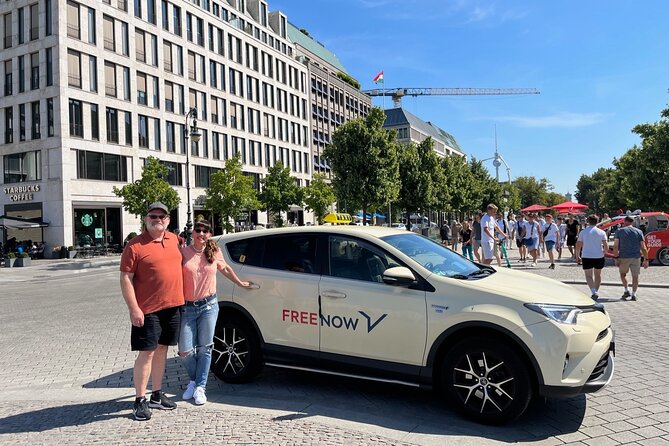
Berlin clicks fast in a taxi. This private sightseeing ride strings together Berlin’s biggest landmarks and its toughest historical lessons, plus an included airport transfer from BER. I love the pace because you can step out for short photo stops at places like the Brandenburg Gate without losing half a day to walking. I also love the way the guide turns symbols into stories, from the Quadriga’s trip to Paris to what the city gate meant after the Wall fell. The main drawback: it’s a drive-and-pause format, so you won’t get museum-level time at every site.
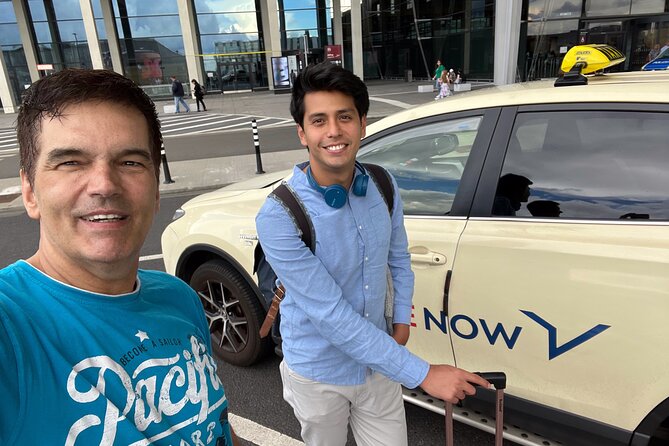
You’re in an air-conditioned vehicle with WiFi on board, and your guide is Gunter Bauer from GAT-Productions. Expect about 1 to 3 hours, in English, with the flexible rhythm of taxi touring—some spots stop, some are drive-pasts depending on time and your interests.
In This Review
- Key highlights you’ll actually feel on the road
- A Taxi Tour That Also Gets You From BER to Berlin
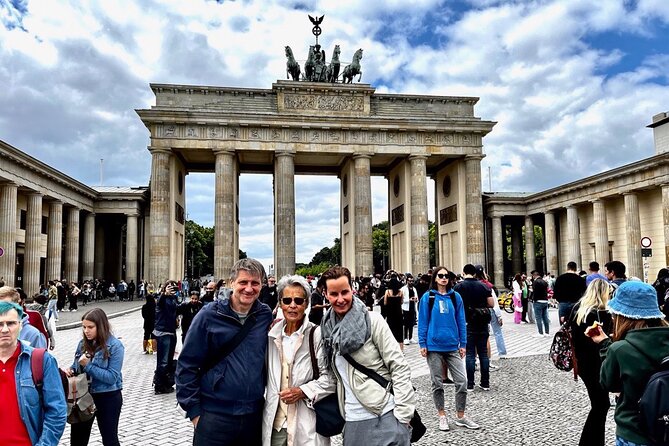
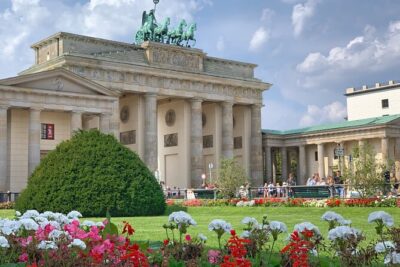
- Brandenburg Gate to Pariser Platz: Power, Propaganda, and a Peace Symbol
- Reichstag, the Chancellery, and the Parliament Machine You Can Actually See
- Checkpoint Friedrichstraße: The Wall’s Logic in One Location
- Unter den Linden to the Big Squares: Berlin’s Main Street With a Story in Every Tree
- Gendarmenmarkt, Bebelplatz, and Neue Wache: Beauty and Grief in the Same Block
- Humboldt Forum, Berlin Cathedral, and Museum Island: Rebuilding After Destruction
- Hackesche Höfe, Sophienkirche Area, and Alexanderplatz: Old Streets and Socialist Big Ideas
- Schöneberg Town Hall and Nikolaiviertel: Real Free Time vs. Rebuilt Looks
- The Lock, Jewish Tailoring District, and the Stelae Memorial: Berlin’s Past as Physical Space
- Potsdamer Platz at Speed: From Death Strip to Entertainment Quarter
- Price Value: Why $171.52 Can Make Sense Here
- Should You Book This Taxi-Based Berlin Tour?
- FAQ
- Is the BER airport transfer included?
- How long is the tour?
- What language is the tour guide?
- Is this a private tour?
- What is included in the price?
- Are admission tickets included?
- Are snacks included?
- What should I do after landing if I booked the airport pickup?
- Is a baby car seat available?
- Are service animals allowed?
- What’s the cancellation policy?
Key highlights you’ll actually feel on the road
- Airport transfer built in: BER pickup for arrivals, plus a farewell transfer back to the airport
- Photo-stop strategy: quick windows at major points so you get the shots without the slog
- Clear, practical narration: history tied to what you see outside the car
- Parliament zone viewpoints: you learn what happens where—speeches vs. committee work
- Wall-era geography made understandable: borders, checkpoints, and transfer routes explained in plain terms
- A mixed Berlin sampler: political Berlin, religious squares, everyday neighborhoods, and postwar squares
More Berlin tours to line up side by side
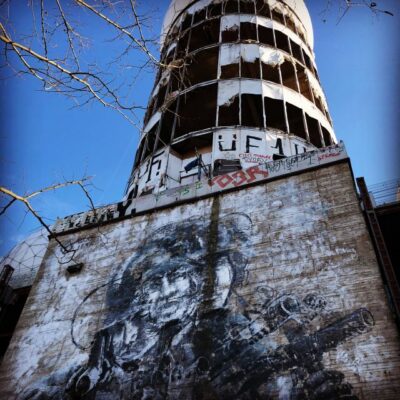
- Berlin: Listening Station Teufelsberg Tour with Transfer★ 4.8 · 354 reviews
- Private Berlin Custom Half-Day Tour with Private Driver and Guide★ 5.0 · 59 reviews
- Berlin Private Transfer to/from Berlin Brandenburg Airport★ 4.0 · 32 reviews
- Minivan Driver and Guide (DIN15565) Tailor Made Berlin Highlights★ 5.0 · 17 reviews
A Taxi Tour That Also Gets You From BER to Berlin
This experience works because it solves a real problem: getting oriented in a city that’s full of wide avenues, big monuments, and “wait, what am I looking at?” moments. Instead of juggling trams, taxis, and scheduling, you get one ride plan that starts at the airport or your hotel and carries you through the core sights.
The taxi format is ideal for the first day in Berlin. You come in jet-lagged, you want to see the map of the city, and you don’t want to over-plan. You also get WiFi and air-conditioning, which sounds small until July or a windy shoulder season day makes it matter.
Brandenburg Gate to Pariser Platz: Power, Propaganda, and a Peace Symbol
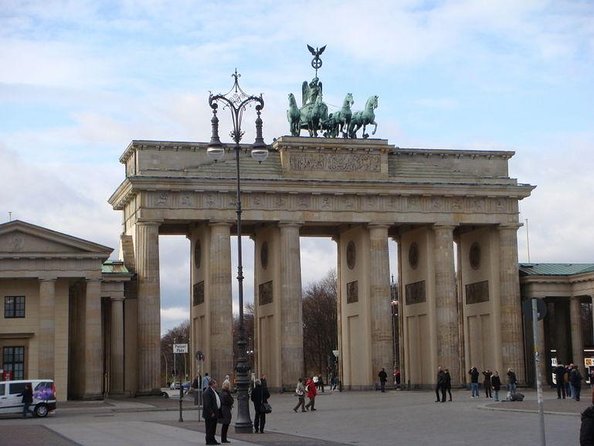
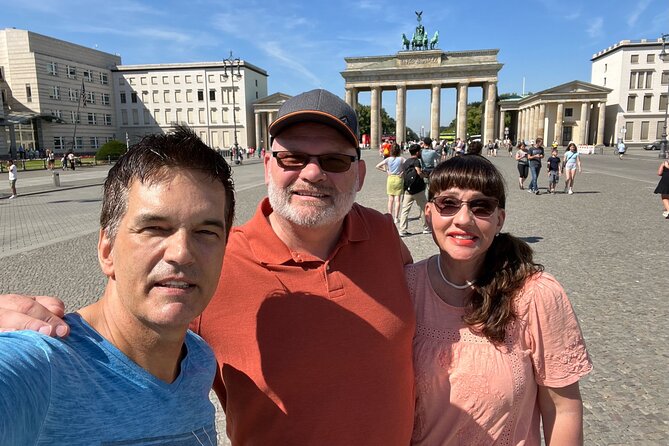
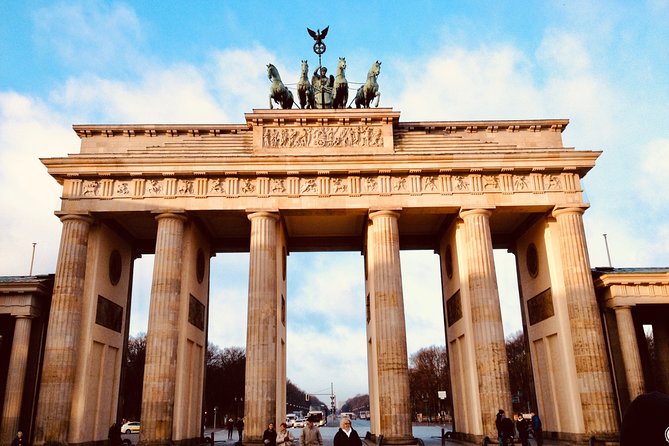
The story usually starts at the Brandenburg Gate, and it’s not just a photo stop. You learn how it began as a city gate and later became a political symbol that kept changing meaning. The guide’s version includes the Napoleonic era, when the Quadriga (the four-horse carriage) was transported to Paris, then returned later in a triumphal procession—so this gate is basically a timeline of whoever held the steering wheel.
What I like here is how quickly the guide connects form to meaning. After World War II and during the division of Berlin, the area around the Gate was treated like a sensitive border zone—torn up by war, then fenced off, then reactivated as a symbol again when the Wall fell.
Next comes Pariser Platz, the kind of place that feels like a front room. It’s also a lesson in reconstruction. After the war and demolition, the Gate was left isolated, cut off from both sides by walls and fences, and even the Hotel Adlon area was blown up. After reunification, the surrounding buildings were rebuilt with modern materials but kept in their historical volume—so you can feel the “before and after” shift while still seeing a recognizable center.
Reichstag, the Chancellery, and the Parliament Machine You Can Actually See
From the Pariser Platz area, the ride moves into Berlin’s government core. The guide points out a few buildings whose size and purpose feel intentionally overwhelming. There’s a reason for that. Berlin’s parliamentary power is meant to look solid, modern, and official, even when you understand that the city’s political history has been anything but stable.
You’ll get a stop and a drive-past rhythm around major government buildings:
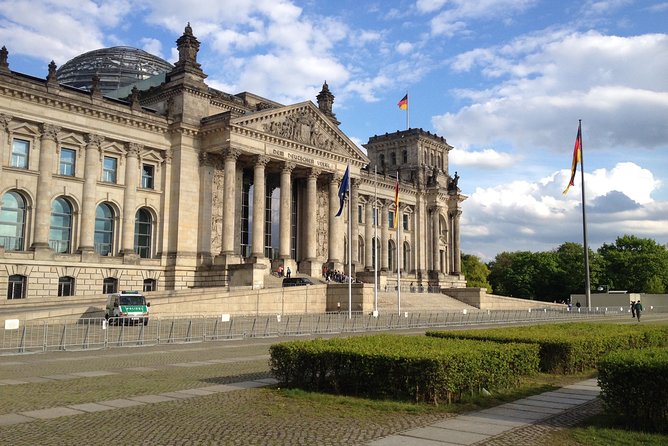
- The Reichstag area, where the story includes how the building’s later shape and the modern glass dome changed the symbolism after reunification. You also hear about the wrapped facade moment connected to Christo.
- The Federal Chancellery building described as a huge, office-heavy structure—ten floors, lots of office rooms, and the chancellor’s office located in the top-left corner in the guide’s telling. There’s also an official apartment in the rotunda area that’s described as unused, which gives you a more human-scale view of what power looks like on the ground.
- Another long parliament working building where the guide explains that committee work happens here, while the final speeches happen in the chamber. That detail matters, because it teaches you how the system actually operates—talking is not the same thing as deciding.
If you like understanding how governments work, not just where they pose, this section is the best payoff per minute.
Checkpoint Friedrichstraße: The Wall’s Logic in One Location
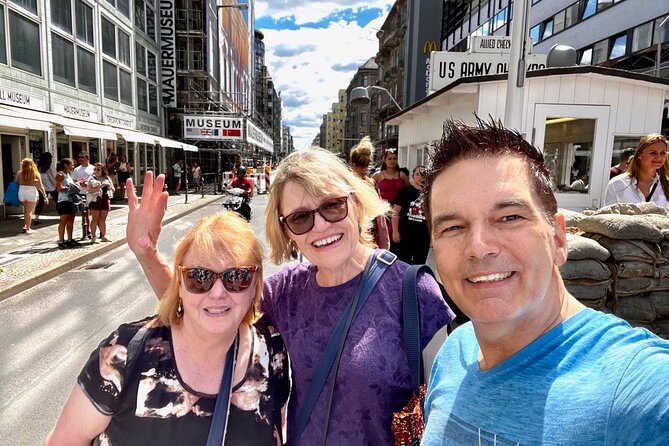
One of the more compelling parts of this ride is the Wall-era “how did people even move?” explanation. The stop is tied to Friedrichstraße station—the only one during the Berlin Wall period that still allowed travel from East to West Berlin.
The guide doesn’t just say “there were barriers.” You learn the practical reality: stations crossed by barriers and customs checkpoints, plus Stasi observation walks as part of the system of control. The Palace of Tears gets mentioned too, which helps connect the station experience to the emotion of separation—people saying goodbye to relatives there, often under the sense that it might be forever.
This is a stop that benefits from your camera and your notebook brain. You’ll understand the map better after this one.




Unter den Linden to the Big Squares: Berlin’s Main Street With a Story in Every Tree
Unter den Linden is the spine of Berlin’s classic center, and the guide’s take makes the boulevard feel planned, not random. You’ll hear how it started as a more controlled path connected to the elector’s hunting grounds—then grew into the grand avenue as the city expanded west. There’s a great detail about the linden trees winning over walnut in the plantings plan, which is the kind of small-but-specific fact you’ll remember later when you’re walking the street yourself.
This part of the ride also helps you see the layers of Berlin’s rebuild. Even when the city looks unified from a distance, the guide shows how the political “edits” changed it: who had access, what was destroyed, and what returned after the Wall fell.
Gendarmenmarkt, Bebelplatz, and Neue Wache: Beauty and Grief in the Same Block
Berlin’s squares can look postcard-perfect and still carry heavy weight. The ride brings you into Gendarmenmarkt with its German and French cathedral story—two church-like buildings that function more like theater-and-museum structures than bishop seats.
In the guide’s framing:
- The German Cathedral side houses a museum focused on parliamentary history.
- The French Cathedral side is still used for services in French by a reformed congregation, with a Huguenot museum behind it tied to refugees who were allowed to build here.
Then comes Bebelplatz, where the ground floor becomes a history lesson. The guide explains how the square is linked to the 1933 Nazi book burnings, and how there’s a glass window in the pavement that reveals an empty library space below. If you’ve ever heard the phrase about history being stamped into cities, this is where you feel it literally under your feet.
After that, Neue Wache brings the mood down for good. The guide connects it to Käthe Kollwitz’s enlarged pietà sculpture—mourning her son who died in World War I after only a few weeks. The memorial is described as a place for all victims of war and terror, with wreath-laying traditions especially around Memorial Day in November.
This trio of stops is why the taxi format works: you get to move quickly between emotional scale and architectural detail without the fatigue of long walks.
Humboldt Forum, Berlin Cathedral, and Museum Island: Rebuilding After Destruction
The ride moves to the Berlin Palace site, rebuilt as the Humboldt Forum, with the opening date mentioned in the guide’s information (2021–22). You’ll hear how the area was erased for decades—first as nothing but open space, later used as a parking lot—and how the Palace’s silhouette survived in war-era memory even after destruction.
Then comes the complicated part: the East German decision to blow up the building despite criticism. The guide’s explanation includes that it was extensively photographed before demolition, which is why the reconstruction could be externally exact. The inner courtyard reconstruction is described too, and the roof terrace view is flagged as a highlight—often the kind of moment that makes people stop and just look at Berlin’s layout from above.
After that, the Berlin Cathedral stop is framed in a very Berlin way. Even though it’s not “old” in the way people assume, the guide points out that it pretends to be older, and that’s part of what makes it interesting. You get a focus on the dome and interior strength, plus the guide ties the building to the broader Berlin theme: compressed time, repeated destruction, and a will to rebuild that stretches across decades.
Finally, Museum Island enters as a quick big-picture orientation. You learn that UNESCO protects five world-famous museums on this northern peninsula of the Spree. The guide ties the sequence of museums together—Old Museum, Neues Museum with early history and ancient Egypt including Nefertiti, the Alte Nationalgalerie as an Acropolis-like picture gallery idea, the Bode Museum for sculptures, and the Pergamon Museum for architecture focused displays.
Important note: this is orientation time more than a ticket-heavy museum day. If you want deep museum time, use this stop to decide which one(s) you’ll return to.
Hackesche Höfe, Sophienkirche Area, and Alexanderplatz: Old Streets and Socialist Big Ideas
Hackescher Markt and Hackesche Höfe are a change of pace. The guide frames this area as small-scale Berlin after the grand political center. It’s also a chance to see preserved 19th-century character while knowing that older Berlin near the red town hall and Nikolaiviertel was heavily destroyed or torn down after the war.
From there, the ride expands into the area around Hamburger Straße with a possible extended component featuring Sophienkirche, the Jewish cemetery, and a Catholic hospital area. The guide’s story here connects the neighborhood to Jewish life across more than one religious community, and mentions the Mendelssohn family connections in older burials nearby.
The synagogue story is also part of the explanation: a Moorish-style new building plan in the 1860s with a golden dome, and how the 3000-member hall was lost in bombings.
Then the ride heads to Alexanderplatz, where you get a lesson in Soviet-influenced socialist redesign concepts in the GDR era. The guide mentions the modernist “statements” like the House of Tourism, House of Statistics, House of the Teacher, House of Electrical Engineering, and the World Clock—so you can read those buildings like a political poster rather than just a skyline.
If your Berlin is a mix of styles, this section is what balances it.
Schöneberg Town Hall and Nikolaiviertel: Real Free Time vs. Rebuilt Looks
The Red City Hall (in the guide’s naming tied to bricks and Schöneberg) gets explained with a simple point: in Berlin, it’s a political center, not a party slogan. You’re told it’s built in a new Gothic style, and that you can visit it for free, at least some interesting rooms, including one with plaster casts of well-known statues. The guide also connects the building to historic town hall locations and how Berlin’s administrative map shifted between East and West.
Then you zoom into Nikolaiviertel, where the guide basically hands you a reality check. The area is described as an 1980s reconstruction in GDR times using old-style backdrops. The guide explains that despite the baroque-looking feel, only a small number of houses existed there and Nikolaikirche’s peak tower roof story was more partial than people might assume.
You’ll get the main points:
- Nikolai Church ends the walk/stop and is now a city museum.
- The garlic house is included as an example of preserved interiors and Biedermeier furnishings.
- The St. Georg context appears as part of the story of Berlin’s symbolic dragon-slaying scene.
It’s fun, but it’s also smart context for understanding how Berlin presents itself.
The Lock, Jewish Tailoring District, and the Stelae Memorial: Berlin’s Past as Physical Space
The ride includes a view of the lock, tied to the oldest crossing of Berlin across the Spree. The guide explains that long before a bridge existed, the river was dammed and water diverted through channels, with mills nearby driven by river water. Later, a small lock became impractical due to the river bend, and in the 1930s the whole system was replaced with a modern double chamber lock.
After that, you’ll hear about HausVogteiPlatz and the surrounding “tidied up after the fall” restored area. The guide’s story focuses on a much-ignored place connected to an old Vogtei facility (with a prison tie in the description) and, later, 19th-century Jewish clothing tailoring. The guide explains that tailor-made work was forbidden under punishment, and even in that setting, tailoring developed into a competition-rich business environment. Even today, mirrors as art objects are referenced as remnants of that past.
Then comes the memorial experience that many people remember long after Berlin leaves your inbox: the stelae installation. The guide describes it as a field of stelae between Brandenburg Gate and Potsdamer Platz, designed by American architect Peter Eisenmann. You’re told the installation initially confuses, but walking through it clarifies the message—confusion, insecurity, and the nightmare of what emigration meant in Nazi Germany, including the recruitment order idea leading to extermination camps. The basement information is called out as part of the experience.
This is one of the most powerful stops, and you’ll be glad you saw it in the middle of a ride that also covered daily streets and everyday architecture.
Potsdamer Platz at Speed: From Death Strip to Entertainment Quarter
The ending portion connects modern Berlin’s entertainment core to a place once shaped by brutal geography. The guide explains that when the Wall was standing, this area was hard to imagine as Europe’s busiest traffic space in the Roaring 20s.
Then the war destroyed 80% of the buildings, and what remained was demolished to create a death strip described as about 80 meters wide. After reunification, development is framed around big names like Sony and Mercedes (then Daimler Chrysler), which helped create a quarter with entertainment and institutions such as the Berlinale Palace, the Film Museum, the Lego Museum, plus cafes, bars, shopping, and offices.
It’s a big pivot, and that’s exactly why it works in a taxi tour: you end with the city as it feels today, while the guide leaves enough historical context that you don’t miss what was erased.
Price Value: Why $171.52 Can Make Sense Here
At $171.52 per person, this isn’t a budget-only deal. But you’re not just paying for narration. You’re paying for a private taxi-style service that bundles:
- Air-conditioned vehicle
- WiFi on board
- Parking fees
- Pickup from your location (hotel/apartment)
- BER airport transfer included in both directions
- Both the taxi ride and the city tour included with VAT details provided
In plain terms: if you’ve got a tight schedule and you want a guided orientation plus airport transfer handled cleanly, it can be good value. It’s especially worth it when you’d otherwise spend time piecing together transport and losing the “what am I looking at?” context.
If you’re traveling light, love long museum sessions, and don’t mind building a route yourself, you might choose a walking tour or transit-based plan instead. But if you want speed with meaning, the price starts to look reasonable.
Should You Book This Taxi-Based Berlin Tour?
I’d book it if you want:
- A fast, guided first pass through Berlin’s core sights
- Airport-to-hotel problem-solving without stress
- Short photo stops with history you can actually remember
- A mix of political Berlin, memorial sites, and central neighborhoods
I’d think twice if you expect hours inside museums and churches every time you stop. This tour is designed for getting bearings fast, not for replacing a full museum day.
If you do book, plan your camera time and your questions. This is the kind of ride where asking what something meant to people at the time makes the whole city click.
FAQ
Is the BER airport transfer included?
Yes. Pickup from BER is included for the welcome tour, and the transfer back to BER is included for the farewell tour.
How long is the tour?
It lasts about 1 to 3 hours (approx.).
What language is the tour guide?
The tour is offered in English.
Is this a private tour?
Yes. Only your group participates.
What is included in the price?
An air-conditioned vehicle, parking fees, WiFi on board, pickup from your desired location in the city, BER airport transfer, and the taxi ride plus city tour are included (VAT is noted for both parts).
Are admission tickets included?
The details say admission ticket free for several specific stops such as the Brandenburg Gate, Pariser Platz, Hackescher Markt, and the Stadtschloss Berlin area. For other stops, ticket information isn’t listed in the provided details.
Are snacks included?
No, snacks are not included.
What should I do after landing if I booked the airport pickup?
You’ll need to send an SMS/WhatsApp directly after landing (and again when you have your suitcases at the baggage carousel). The guide also notes waiting near the arrivals hall, in a specific lane.
Is a baby car seat available?
Yes. A MaxiCosy baby car seat is available on request.
Are service animals allowed?
Yes, service animals are allowed.
What’s the cancellation policy?
Free cancellation is available up to 24 hours in advance for a full refund.
More Private Drivers in Berlin




More Tours in Berlin


More Tour Reviews in Berlin
Round out your days in Berlin
Private Drivers, compared.
 ★ 4.8Listening Station Teufelsberg Tour with TransferFrom $62354 reviews
 ★ 5.0Private Berlin Custom Half-Day Tour with Private Driver and GuideFrom $36159 reviews
 ★ 4.0Berlin Private Transfer to/from Berlin Brandenburg AirportFrom $5732 reviews
 ★ 4.5Private Transfer from Berlin to Prague with 2h of SightseeingFrom $31817 reviews
 ★ 5.0Minivan Driver and Guide (DIN15565) Tailor Made Berlin HighlightsFrom $41517 reviews
 ★ 3.5Private One way Airport Transfer Berlin Airport To BerlinFrom $6317 reviews
 ★ 4.5Private Transfer from Berlin to Prague with 4h of SightseeingFrom $3517 reviews
 ★ 5.0Private Transfer from Berlin to Prague, Hotel-to-hotel, English-speaking driverFrom $2723 reviews
Browse the lists this tour appears in