
REVIEW · BERLIN BIKE TOURS
Berlin : The best bike tour with a Berlin guide and insider tips
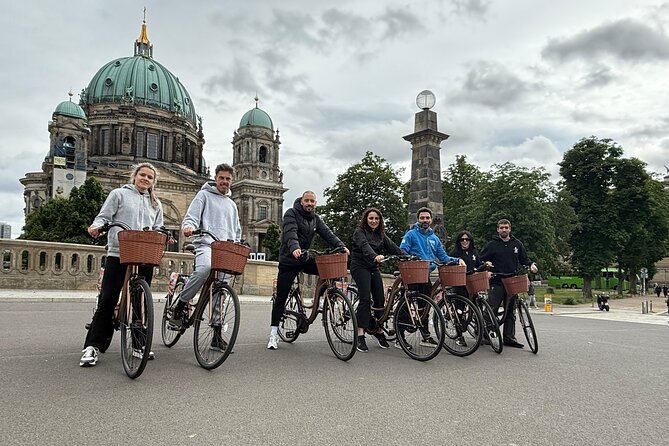
Berlin rewards you most when you move. This 3-hour bike tour strings together Wall history, Holocaust remembrance, and big-city landmarks with an easy flow and English guidance to make sense of what you’re seeing. What makes it work is the pacing: quick photo stops, enough time to look, and a route that keeps you from losing half the day to transit.
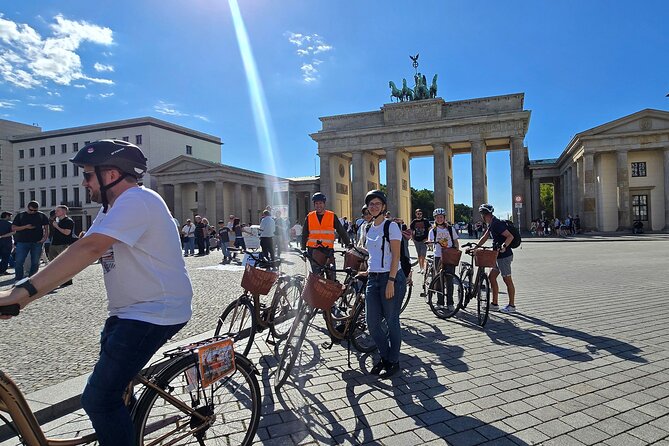
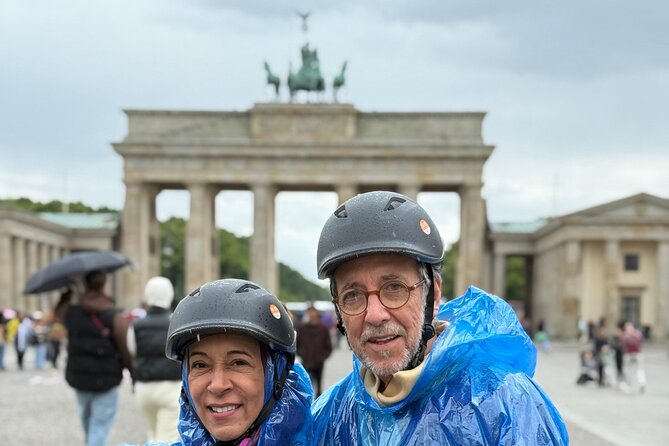
I especially like the mix of emotion and architecture: you’ll pass Checkpoint Charlie, the Holocaust Memorial, and the Brandenburg Gate in one sweep, so the story of division to unity feels immediate. I also like that the tour stays small, with a maximum of 10 people, which usually means less waiting and smoother riding. One drawback to consider is that the stops are short, so if you want long museum-style time inside places, you may feel a bit rushed and you’ll still likely need separate entry plans since admissions aren’t included.
In This Review
- Key things that make this ride worth it
- Why Berlin looks different from a bike seat
- Getting started at Lindenstraße: how the logistics stay painless
- Checkpoint Charlie: the Wall in miniature
- Topography of Terror: where fear had an office
- The former no man’s land square: from busy to silent
- Hitler’s final refuge: the Fuhrerbunker site
- Holocaust Memorial to Brandenburg Gate: remembering and reframing the city
- A central park break: Berlin’s big breathing space
- Bellevue Palace and the government district feel
- The Reichstag and its glass dome idea of transparency
- Museum Island from the bike: UNESCO-scale without the museum commitment
- Alexanderplatz and Nikolaiviertel: modern transit meets older streets
- Bebelplatz: the site of Nazi book burnings
- Gendarmenmarkt to finish: architecture you can feel in photos
- Price and value: what you’re really paying for
- Who should book this bike tour (and who should skip)
- Should you book it?
- FAQ
- How long is the bike tour?
- What does the tour cost?
- Is the tour in English?
- Is a bike included?
- Are meals included?
- Are admission tickets included for the stops?
- Where does the tour start and end?
- How big is the group?
- Do I need a printed ticket?
- Is there free cancellation?
Key things that make this ride worth it
- Wall-era sites fast and clear: major checkpoints and memorial spots without getting bogged down
- Small-group bike time: max 10 people helps the tour feel organized
- Stops built for photos: you get time to look around and take pictures at key viewpoints
- English-led storytelling: the guide explains what’s behind the sights in straightforward terms
- Big landmarks plus calm corners: from government buildings to Berlin’s central park mood
More of Berlin by bike
- Berlin: Sights and Highlights Bike Tour with a Local Guide★ 4.8 · 2,698 reviews
- Berlin Highlights 3-Hour Bike Tour★ 5.0 · 948 reviews
- Berlin Highlights: 3-Hour Bike Tour★ 4.9 · 809 reviews
- Berlin Highlights Sightseeing Bike Tour in Small Groups★ 5.0 · 652 reviews
Why Berlin looks different from a bike seat
Berlin can feel huge on foot. On a bike, the city suddenly makes sense: distances shrink, crossings get simpler, and you can actually compare neighborhoods in a way that matches how Berlin grew. This tour is built for that. It’s short enough (about 3 hours) to be doable even on a packed schedule, but long enough to cover far more ground than a walking loop.
You also get an interesting rhythm. Some stops are heavy and reflective (Wall history, Gestapo-linked sites, Holocaust remembrance). Others are about scale and symbolism (the Brandenburg Gate, the glass dome idea at the Reichstag). The guide keeps the thread moving, so it’s not just a list of monuments.
The route starts and ends at Lindenstraße 28 (10969). If you like getting your bearings fast and then letting the rest click, this format fits.
Getting started at Lindenstraße: how the logistics stay painless
The meeting point is easy to reach, with the listing noting it’s near public transportation. The tour uses a mobile ticket, so you’re not hunting for printouts. That matters in Berlin, where trams and U-Bahn lines can save you time when you’re pre-positioning yourself before a bike ride.
Because the group is capped at 10, the ride tends to stay controlled. You’re not weaving through a crowd. You’re also not spending the whole tour waiting while someone catches up at each stop. That small-group setup is one of the most praised aspects, and it shows up in how smoothly the tour moves.
One practical thought: this is a bike tour. If you’re not comfortable riding in city traffic, you may want to think twice. The good news is that the tour is short, so you’re not stuck for hours if you’re only mildly confident on a bike.
Checkpoint Charlie: the Wall in miniature
You start with Checkpoint Charlie, the best-known border crossing between West and East Berlin during the Wall era. Even if you’ve seen it in photos, it hits differently when you’re actually in the area. The story is concrete: what had been a route for people and commerce became a choke point, and the city’s daily life got rewritten around that fact.
The stop is brief (about 10 minutes), so don’t plan this as a long museum visit. Instead, treat it as a launch point. I like using early stops like this to set the emotional temperature for the rest of the tour. Once you understand the logic of the border here, later stops about repression and resistance make more sense.
If you’re the kind of person who likes details, this is where those details matter. The guide helps translate what the location represents, so it’s not just a name on a sign.
Topography of Terror: where fear had an office
Next is Topography of Terror, tied to the former Gestapo headquarters and the way persecution was carried out through official power. The tour frames the place in a stark way: plans for persecution and torture of Sinti, Roma, and Jews were connected to this area during World War II.
This is one of those stops where the short time can feel both right and slightly unsettling. Right, because you’re not numbed by too much staring. Slightly unsettling, because you’re learning about real suffering without the comfort of a longer, museum-style pacing.
Also note the practical item: admission tickets aren’t included. If you want deeper exhibits beyond what you can see from the outdoor viewing areas, you’ll need to plan for that separately. For many people, though, the guided explanation plus the location itself is enough to leave an impact.
More Berlin tours to line up side by side
The former no man’s land square: from busy to silent
After Topography of Terror, the route points you toward an area that captures how the Wall changed city life. The tour passes a square that was lively before World War II, then became deserted starting in 1961, sitting in the border zone between East and West Berlin.
I find this kind of stop important because it shows the Wall wasn’t only about guards and checkpoints. It reshaped public space. It altered what people could do, where people could go, and even whether streets felt alive. On a bike, you can see the surrounding city layout quickly, which makes the change feel less abstract.
Because this stop is short, it’s best approached with one question in mind: what would you miss if your neighborhood became off-limits? The guide’s explanation helps you connect the dots.
Hitler’s final refuge: the Fuhrerbunker site
Then comes the Fuhrerbunker. The tour notes that Hitler’s last refuge in Berlin ended with his suicide on 30 April 1945, and that today only a parking lot with an information board is what you can readily see.
This is a good example of why having a guide matters. If you stop at a nondescript lot and read just the basics, you get the general outline. With a guide, you get the meaning behind why the place still matters, and why it feels strangely quiet compared to what it represented.
The stop time is around 5 minutes. That’s intentional. It keeps the tour moving and prevents the ride from turning into an emotional marathon. Still, it’s a moment where I’d suggest slowing down your photos and letting the story land.
Holocaust Memorial to Brandenburg Gate: remembering and reframing the city
The tour moves directly into the Holocaust Memorial—the Memorial to the Murdered Jews of Europe. It’s described as 2,711 concrete stelae near the Brandenburg Gate, designed to encourage reflection and remembrance. Even with a short stop (about 5 minutes), the location works because it sits right in the heart of modern Berlin’s most symbolic area.
From there, you pedal toward Brandenburg Gate, built in 1791 and later used as a symbol of division—then later unity. The guide helps you see it as more than a postcard. This is one of those sights where you’ll get the most out of the visit if you think about time layers: how the same structure can mean different things depending on who controls the city.
The stop is listed at around 10 minutes. That’s enough for pictures and a quick mental reset before you move into the political core.
Tip for timing: plan your photos so you don’t keep rushing. People often spend too long trying to capture the perfect angle and forget to look around. Here, looking around matters.
A central park break: Berlin’s big breathing space
Between the major monuments, the tour includes time in Berlin’s central park area, described as reminiscent of New York’s Central Park. This is a smart design choice. When you spend time around memorials and government buildings, your brain needs a change of pace. A park stop gives you that without breaking the schedule.
The “about 5-minute” type of stops listed at other points suggest the tour keeps things moving, but a park is one place where even short time can refresh your energy. You can stretch your legs, regroup your attention, and take in how Berlin handles open space.
No admissions are mentioned here, so it’s mainly about scenery and recovery.
Bellevue Palace and the government district feel
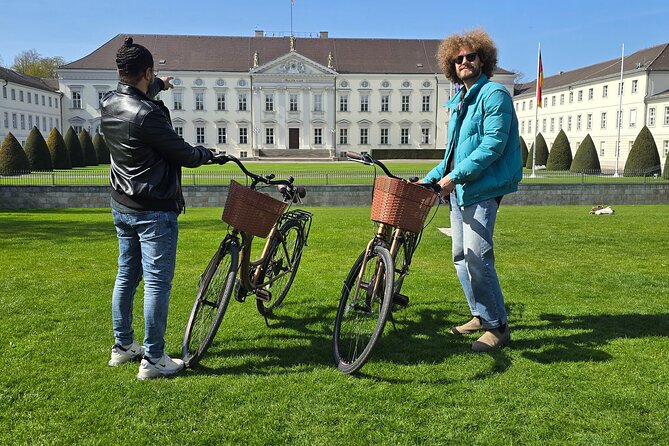
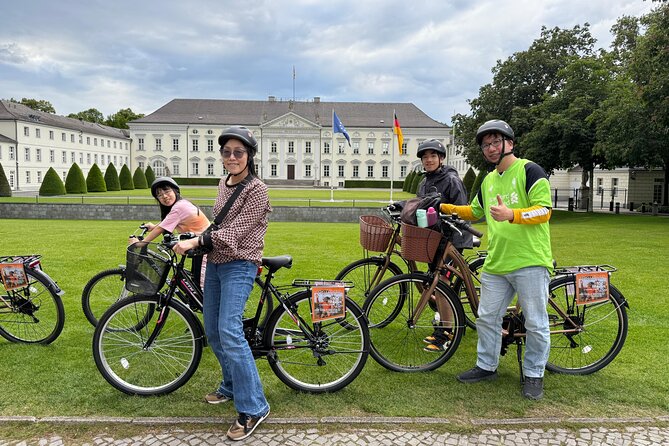
Next up is Bellevue Palace, described as the headquarters of the German Federal President. The tour includes a short viewing time (around 5 minutes). At first glance, it’s an impressive official building. With the bike tour context, it becomes part of a bigger pattern: Berlin’s political center is built in layers.
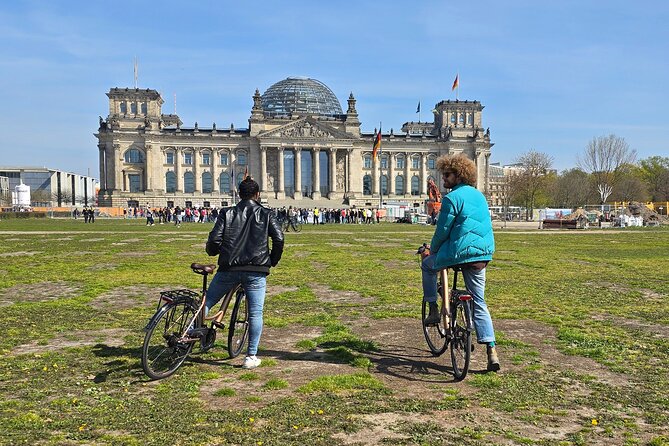
The route also passes through the broader government district area around the Reichstag and the Spree, noted as the heart of German politics. If you’ve only ever seen the Reichstag from a distance, this kind of surrounding context helps. It turns a single building into a whole setting.
Since admissions aren’t included, treat these as look-and-learn stops. The value here is how the guide frames the space and what you should notice while you’re there.
The Reichstag and its glass dome idea of transparency
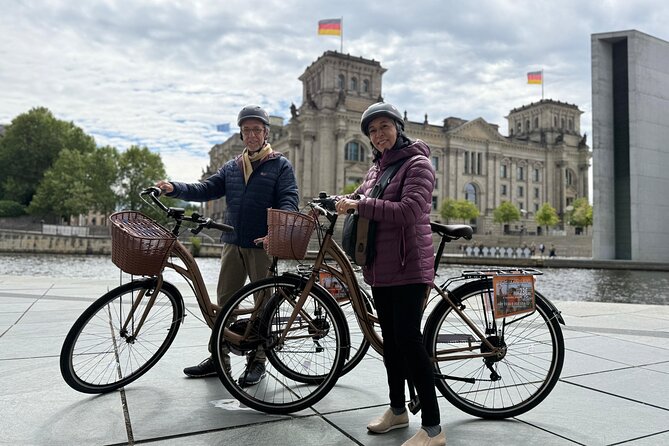
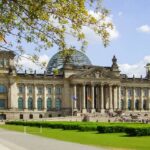
The tour’s Reichstag Building stop is a short one (about 5 minutes), but it centers on a key detail: the glass dome, which symbolizes transparency of policy. That line matters because it helps you understand why this building is more than architecture. Berlin isn’t just showing power. It’s also showing an idea of accountability.
Even if you only get a quick look, you can still connect the symbolism back to the earlier parts of the tour about division and control. It’s an interesting contrast: from fear and enforced borders to a modern political image tied to openness.
If you’re curious about going inside or seeing more, remember the tour doesn’t include admissions. You may need separate plans if you want that deeper experience.
Museum Island from the bike: UNESCO-scale without the museum commitment
Then the route heads toward Museum Island, a UNESCO World Heritage Site in the Spree area. The tour mentions it houses five important museums, including the Pergamon Museum and the Neues Museum.
This is a great stop for people who want culture without turning the day into a long-ticket project. The tour time is around 10 minutes, so you’re not going deep into exhibits. Instead, you get the big-picture sense of where Berlin invests in art and scholarship.
If you’re the kind of person who loves planning a museum day, this stop can also help you decide what you want to see later. You’ll likely remember the names mentioned here, and that makes future ticket choices easier.
Alexanderplatz and Nikolaiviertel: modern transit meets older streets
The tour then includes Alexanderplatz, described as a central square and transport hub. It’s known for the TV tower, the World Clock, and shopping. The tour also notes it used to be a flagship socialist project of the GDR. That makes the square more interesting than a place to pass through. You’re seeing how politics shaped public space in the GDR era.
After that, you visit Nikolaiviertel, described as the oldest residential district in Berlin, close to the Spree and Alexanderplatz, founded in the Middle Ages and reconstructed in the 1980s. It’s framed today as a historic place with restaurants, alleys, and the St. Nicholas Church.
This is a nice contrast. Alexanderplatz is big-scale, modern, and functional. Nikolaiviertel is smaller-scale and street-level. On a bike tour, that contrast is what keeps the day from feeling repetitive.
Bebelplatz: the site of Nazi book burnings
Next is Bebelplatz, known for the burning of books by the Nazis on 10 May 1933. Today, the tour points out an underground memorial of empty bookshelves.
This stop is short (about 10 minutes), but it’s loaded with meaning. The guide helps you connect the idea of censorship to a physical location. And the underground memorial makes the message feel personal: it’s not abstract. It’s a hole where knowledge should have been.
Again, admissions aren’t included, so your main experience is the guided explanation and what you can see on site.
Gendarmenmarkt to finish: architecture you can feel in photos
The tour ends at Gendarmenmarkt, described as one of Berlin’s most beautiful squares, shaped by the German Cathedral, French Cathedral, and the Konzerthaus. This is where the tour’s final tone becomes light enough for easy photos and a relaxed last look.
It’s short (around 5 minutes), but Gendarmenmarkt works because the architecture gives you built-in framing. You don’t need a lot of creativity to get good images. You just need to stand where the buildings line up.
As a finishing point, it’s smart. After heavier sites, you land somewhere that feels ordered and graceful.
Price and value: what you’re really paying for
The price is listed at $36.57 per person for about 3 hours, with the bike included and English offered. That’s not just “a cheap way to ride.” You’re paying for interpretation. The stops span checkpoints, repression-linked locations, Holocaust remembrance, and government symbols. Without guidance, it’s easy to see names and miss meaning.
Also, this tour uses a short-stop approach. That’s a value play. You cover major Berlin without the time sink of moving between far-flung areas on foot.
Meals aren’t included, so plan to eat before or after. Admission tickets aren’t included either, so if any site calls you in deeper, budget for separate entry where needed.
One more practical value point: the tour is designed for efficiency. It’s average booked about 27 days in advance, which is a gentle hint that slots can fill. If you’re traveling in busy seasons, don’t wait until the last week.
Who should book this bike tour (and who should skip)
This tour is a strong match if you:
- want a time-efficient overview that still covers heavy topics responsibly
- like city-watching from a bike and prefer organized stops over self-guided guessing
- want an English guide who can connect the dots without turning it into a lecture
You might want to skip or choose something else if:
- you’re not comfortable biking in a city setting
- you want lots of museum time at indoor exhibits, since stops are short and admissions aren’t included
- you’re seeking a fully unstructured, slow wandering day
Should you book it?
If you want Berlin in one solid, guided ride, I’d book this. The biggest wins are the small group size (max 10), the pacing that gives you time to look and take pictures, and the way the guide makes the story clear in English. It’s a rare mix of practical sightseeing and meaningful context, done in a manageable chunk of time.
If you’re the kind of visitor who likes to bounce between major highlights and also come away understanding what they mean, this is an efficient route worth your money.
FAQ
How long is the bike tour?
It’s about 3 hours.
What does the tour cost?
The price is $36.57 per person.
Is the tour in English?
Yes. The tour is offered in English.
Is a bike included?
Yes. Bicycle use is included.
Are meals included?
No. Meals are not included.
Are admission tickets included for the stops?
No. Admission ticket(s) are not included.
Where does the tour start and end?
It starts at Lindenstraße 28, 10969 Berlin, Germany and ends back at the meeting point.
How big is the group?
The tour has a maximum of 10 travelers.
Do I need a printed ticket?
No. You get a mobile ticket.
Is there free cancellation?
Yes. Free cancellation is available, and you can cancel up to 24 hours in advance for a full refund.
More Tours in Berlin
More Tour Reviews in Berlin
Berlin by Bike


Round out your days in Berlin
Berlin Bike Tours, compared.
 ★ 4.8Sights and Highlights Bike Tour with a Local GuideFrom $412,698 reviews
 ★ 5.0Berlin Highlights 3-Hour Bike TourFrom $42948 reviews
 ★ 5.0Berlin City Bike Tour with Beer Garden StopFrom $83917 reviews
★ 4.9Berlin Highlights: 3-Hour Bike TourFrom $37809 reviews
★ 5.0Berlin City Bike Tour with Beer Garden StopFrom $83917 reviews
★ 4.9Berlin Highlights: 3-Hour Bike TourFrom $37809 reviews
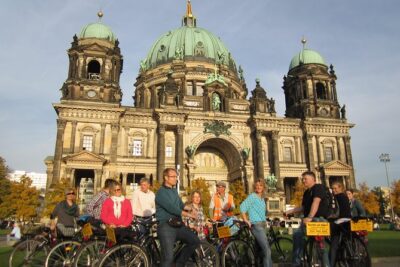 ★ 5.0Berlin Highlights Sightseeing Bike Tour in Small GroupsFrom $43652 reviews
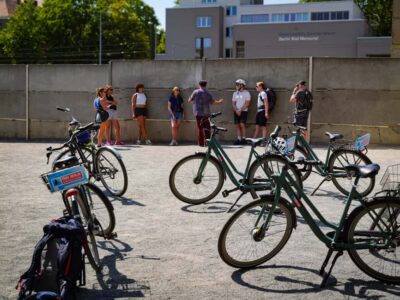 ★ 4.8The Wall and Third Reich Guided Bike TourFrom $41578 reviews
 ★ 4.7Alternative Bike Tour of Kreuzberg & FriedrichshainFrom $41548 reviews
 ★ 4.8Guided Bike Tour to Explore the HighlightsFrom $41506 reviews
Browse the lists this tour appears in