
Berlin changes fast when you ride it. This small-group bicycle tour shows me a Berlin that feels lived-in, not staged, mixing big political landmarks with everyday neighborhood streets. I especially love the Bornholmer Straße 9 November 1989 border-crossing stop and the way the ride finishes with the weight of the Stasi prison at Hohenschönhausen. One thing to consider: it’s a real 4–4.5 hour ride, and there’s no built-in coffee break, so pack a snack and plan to stay focused.
The format matters here: it’s capped at max 8 people, so you don’t spend half the time waiting for a straggler. Plus you get bike hire and an English or German guide who can explain what you’re seeing in plain language (I learned a lot from guides like Katrin and Steffen). If you hate rainy rides, good news: tours run in wet weather and you get a rain cape.
In This Review
- Five Districts, One Berlin Story You Can Actually Feel on a Bike
- Getting Started at Bornholmer Straße 75A (and Why It Sets the Tone)
- Zeiss Großplanetarium in Thälmannpark: Science, Symbolism, and a Different Berlin Moment
- The Velodrom Built for Olympia 2000: Big Sports Architecture With Edges
- Sportforum and Training Culture: Where Berliner Eisbären and BFC Dynamo Fit In
- Mies van der Rohe Haus: Architecture on a Human Scale
- Orankesee and Bethanienkirche: Where Berlin’s Green Breaks Up the Ride
- Weißensee’s Artisan Side and Hohenschönhausen’s Stasi Prison: The Tour’s Emotional Center
- Timing, Pace, and What to Wear So You Enjoy the Full 4 Hours
- Bike Hire, Group Size, and Why the Price Can Make Sense
- Who This Tour Fits Best (and Who Might Want Something Else)
- Should You Book Undiscovered Berlin by Bike?
- FAQ
- How long is the tour?
- How big is the group?
- Is this a private group?
- Where does the tour start?
- What’s the closest public transport to the meeting point?
- What’s included in the price?
- What languages does the guide speak?
- Does the tour run in bad weather?
- Are large bags allowed?
- What’s the cancellation policy?
Five Districts, One Berlin Story You Can Actually Feel on a Bike
This tour works because it doesn’t just point at famous places. You move through Berlin in a way that makes contrasts obvious: architecture shifts, street rhythms change, and the city’s past shows up as physical buildings, not just history books.
It’s also designed for people who already know Berlin’s headline attractions. If you’ve visited Brandenburg Gate and the Wall memorials downtown, this is the next layer: neighborhoods and sites that many first-timers skip, even when they stay long enough to “see everything.”
Finally, the small-group size changes the experience. With fewer people, the guide can pace the group, answer questions, and tailor little bits of context without turning the ride into a lecture.
Still narrowing down your days in Berlin? Here are more tours to weigh up.
- Berlin: Reichstag, Dome and Government District Guided Tour★ 4.7 · 18,288 reviews
- Berlin: 1-Hour City Tour by Boat with Guaranteed Seating★ 4.3 · 16,993 reviews
- Berlin: TV Tower Standard Entrance Ticket★ 4.4 · 15,883 reviews
- Berlin: Boat Tour Along the River Spree★ 4.4 · 11,252 reviews
Getting Started at Bornholmer Straße 75A (and Why It Sets the Tone)
The tour begins at Bornholmer Straße 75A, right by a key Cold War location: Platz des 9. November 1989. That matters because the tour’s theme is division and change, and starting here puts you in the right mental mode immediately.
Logistically, it’s easy to reach. The closest tram stop is Björnsohnstraße (M1, M13, M50), about a minute on foot. Bornholmer Straße S-Bahn is roughly two minutes away, and U-Bahn at Schönhauser Allee is about a 10-minute walk.
If you’re the type who likes to understand a place before you get moving, start a few minutes early. You’ll get your bearings fast, and you’ll be ready for the history that’s about to show up in buildings and street layout.
Zeiss Großplanetarium in Thälmannpark: Science, Symbolism, and a Different Berlin Moment
One of the first major stops is the Zeiss Großplanetarium in Thälmannpark, associated with the Ernst Thälmann Memorial area. This is a smart early stop because it’s not the usual postcard view of Berlin. You’re in a site that suggests a different worldview—big public institutions built to shape culture and ideas.
From there, the tour’s story widens. You’ll ride past areas shaped by industrial Berlin, and you’ll hear how former working sites (including a former stock yard and abattoir area) ended up blending with newer building activity. That combination is one of Berlin’s most practical realities: old structures don’t vanish; they get repurposed, and the city keeps layering its eras.
This segment is also where the tour often “clicks” for people. Instead of looking at the past as distant, you see it embedded in spaces you can still walk and ride through.
The Velodrom Built for Olympia 2000: Big Sports Architecture With Edges
Next up is the Velodrom, built for Olympia 2000. It’s the kind of stop that feels visual even if you know nothing about the event history: a big, distinctive sports venue that helps you understand how post-war Berlin invested in large-scale projects.
What I like about this stop is the way a cycling tour lets you read scale. From street level, you get a better sense of how the venue sits in its surrounding neighborhood than you would from a single viewpoint.
It also acts like a bridge. You’ve just covered history tied to political change and public institutions; now you shift to another slice of Berlin life—sports and training culture—without losing the thread.
Sportforum and Training Culture: Where Berliner Eisbären and BFC Dynamo Fit In
The tour then goes to the Sportforum. This is the former home of the Berliner Eisbären and BFC Dynamo teams, and it’s also tied to many well-known athletes’ training.
Again, the value isn’t just naming teams. On a bike, you can better grasp why places like this mattered: sports weren’t a separate world from politics and society. The guide’s explanations help you connect the physical space to the culture around it.
If you like understanding how Berlin organizes its communities, this stop is a good marker. You come away thinking differently about what “public life” looks like in the city, especially in areas that weren’t always built for tourists.
Mies van der Rohe Haus: Architecture on a Human Scale
You’ll make a stop at Mies van der Rohe Haus. Even if you don’t consider yourself an architecture person, it’s a useful reset during a 4-hour ride: you’re not only hearing stories, you’re also noticing design choices you can see with your own eyes.
This is the kind of stop that helps break up a ride emotionally. The tour has heavy material later, and these more design-oriented moments give you room to absorb it without feeling like the trip is one long political lesson.
If you enjoy modernist buildings and how they shape movement through space, you’ll likely get more from this stop.
Orankesee and Bethanienkirche: Where Berlin’s Green Breaks Up the Ride
As the tour continues, you hit Orankesee. This is a welcome change of pace because it’s tied to the city’s lakes and green spaces—something that can surprise people who only picture Berlin as concrete and history.
Then you move toward Bethanienkirche, another stop that helps you see Berlin as more than just monuments. Places like this remind you that Berlin’s identity is also shaped by everyday civic and community spaces.
In practical terms, these stops are good for your body too. After a few hours riding, scenery shifts matter. Even short segments of “stop, look, regroup” make a difference.
Weißensee’s Artisan Side and Hohenschönhausen’s Stasi Prison: The Tour’s Emotional Center
One of the tour’s biggest highlights is the contrast between up-and-coming life and past oppression.
On the life side, you get to experience the artisan community in Weißensee. This is exactly the kind of neighborhood texture that makes Berlin feel current rather than frozen in time. You’re not just passing through; you’re learning how new creative energy fits into older urban structure.
Then comes the weight: the tour includes the former Stasi prison at Hohenschönhausen. This is the part where the tour earns its name, Undiscovered Berlin, because it’s the kind of site that demands context more than it needs scenic framing.
The best way to approach this segment is mentally prepared for serious history. Ask questions if your guide offers them. A good guide won’t treat it like a checklist stop—they’ll help you understand why the buildings and routines mattered, and how the site fits into the wider story of Berlin’s division.
If you’re short on time but want one part of Berlin that will genuinely change how you see the city, this is often it.
Timing, Pace, and What to Wear So You Enjoy the Full 4 Hours
This tour is listed at 4 hours, and in real life you might feel closer to 4.5 hours depending on the group and pacing. One review note even flagged the ride as a bit tiring due to the total time.
So here’s my practical advice:
- Wear comfortable shoes you can walk in around stops.
- Bring a small snack, especially if you dislike riding on an empty stomach.
- If you’re sensitive to cold or rain, dress for wet weather since the tour runs regardless of weather.
The good news is that you get a rain cape if it’s raining, and you’ll be on a bike rather than walking every stretch. Still, it’s not a sit-down sightseeing bus day.
Bike Hire, Group Size, and Why the Price Can Make Sense
The price is $224 per group up to 5, for a 4-hour experience that includes bike hire, a tour guide, and a rain cape when needed.
Value-wise, this can be a very reasonable deal if you’re traveling with friends or family who will actually ride. If you split the group price across multiple people, the per-person cost gets much easier to justify compared with paying for separate tickets and separate guides.
It’s also a good fit if you care about explanation quality. A small-group bike tour gives you access to a guide for the whole time, not just at a couple photo stops.
One small consideration: since the tour is capped at max 8 people, you may not get to choose perfect group composition if you book last minute.
Who This Tour Fits Best (and Who Might Want Something Else)
I’d point you to this tour if:
- You want Berlin history connected to real places across multiple districts.
- You’ve already seen the major central highlights and want quieter, more specific areas.
- You like biking as a way to cover ground without rushing through it.
- You enjoy guides who explain context in plain language.
I’d think twice if:
- You hate longer bike time and prefer quick, low-effort sightseeing.
- You need frequent scheduled breaks. A coffee stop isn’t part of the setup, so bring your own timing.
If your goal is to understand how Berliners live now while seeing the traces of the past that still shape the city, this tour delivers.
Should You Book Undiscovered Berlin by Bike?
Yes, if you want a small-group ride that shows you parts of Berlin most itineraries skip—especially the border-crossing story and the Stasi prison site in Hohenschönhausen. The bike format makes the districts feel connected, and the small group size helps the guide actually teach, not just manage.
Book it when you can handle 4 hours in the saddle and when you’re ready for a serious historical segment. If that sounds like your kind of Berlin day, this is a strong choice.
FAQ
How long is the tour?
The tour runs for 4 hours.
How big is the group?
The tour is designed for a small group, with a maximum of 8 people.
Is this a private group?
It’s a private group tour.
Where does the tour start?
It starts at Bornholmer Straße 75A, 10439 Berlin.
What’s the closest public transport to the meeting point?
The nearest tram stop is Björnsohnstraße (about 1 minute). Bornholmer Straße S-Bahn station is about 2 minutes on foot, and U-Bahn Schönhauser Allee (U2) is about a 10-minute walk.
What’s included in the price?
Bike hire, a tour guide, and a rain cape if it’s raining are included.
What languages does the guide speak?
The live tour guide is available in English and German.
Does the tour run in bad weather?
Yes, the tour runs regardless of the weather, and rain ponchos are available.
Are large bags allowed?
No. Luggage or large bags are not allowed.
What’s the cancellation policy?
You can cancel up to 24 hours in advance for a full refund. If your group is more than 3 people, the cancellation deadline is 3 days before the scheduled tour.
More Tours in Berlin
More Tour Reviews in Berlin
Round out your days in Berlin
Tours, compared.
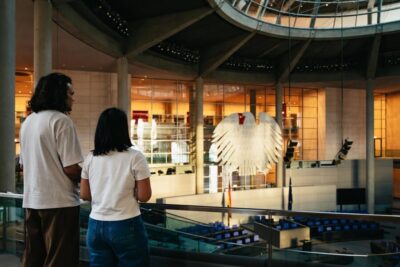 ★ 4.7Reichstag, Dome and Government District Guided TourFrom $1818,288 reviews
 ★ 4.31-Hour City Tour by Boat with Guaranteed SeatingFrom $2516,993 reviews
 ★ 4.4Boat Tour Along the River SpreeFrom $3411,252 reviews
 ★ 4.3Hop-on Hop-off Bus Tour with Live CommentaryFrom $228,579 reviews
 ★ 4.6Reichstag, Plenary Chamber, Cupola & Government TourFrom $188,422 reviews
 ★ 4.9Third Reich & Cold War Guided Walking TourFrom $238,378 reviews
 ★ 4.9Discover Berlin Walking TourFrom $235,998 reviews
 ★ 5.0Sachsenhausen Concentration Camp Tour in EnglishFrom $365,711 reviews