
REVIEW · WALKING TOURS
An Introduction to Berlin Walking Tour
Berlin’s power points are everywhere on this walk. I like the small-group pace and the historian-style storytelling that ties together centuries of change, from Prussian militarism roots to 20th-century Berlin. You’ll hit big sights like the Reichstag glass dome, Brandenburg Gate, and Berlin Wall–era areas with smart, efficient stop times. One catch: the route is built for coverage, so you’ll use public transport a few times instead of pure foot-power.
I also like that the stops are free to enter, so your money goes to your guide, not ticket lines. And because the group maxes at 8, you’ll usually get more back-and-forth than on mega-tours. If you hate walking on busy streets or want zero transit hops, you may find the logistics a bit more active than you expect.
In This Review
- Key reasons this Berlin route works
- Reichstag Building and the Foster dome: Germany’s democracy, up close
- Brandenburg Gate: from Prussian kings to Cold War memory
- Museum Island’s big-name museums without museum-day overload
- Potsdamer Platz: the Wall’s shadow and the square’s restart
- Unter den Linden to Tiergarten: grand boulevard to inner-city pause
- Holocaust Memorial: the walk-in part you should take slowly
- Hackescher Markt courtyards: pre-war Art Nouveau details at street level
- What you actually get in 3 hours for $156.53
- Getting around efficiently: transit hops and a day pass check
- Guide style: why a small group feels different here
- Should you book this Berlin walking tour?
- FAQ
- How long is the Berlin walking tour?
- What is the group size for this tour?
- What language is the tour offered in?
- Where does the tour start and end?
- What’s included in the price?
- Do I need admission tickets for the stops?
- Will I need public transportation during the tour?
- What is the cancellation policy?
Key reasons this Berlin route works
- Small group (max 8): more attention, easier questions, better flow between stops
- Historian-led: you’re not just viewing buildings; you’re getting the “why it matters” story
- A tight 3-hour arc: you move from the Reichstag and Prussian symbolism to Wall-era places and memory sites
- Architectural anchors: glass dome, neoclassical gate, museum cluster, grand boulevard—all connected by explanation
- Free entry at the listed sights: value stays focused on the guide, not admissions
More of Berlin on foot
- Discover Berlin Half-Day Walking Tour★ 5.0 · 9,624 reviews
- Berlin City walk Government District and Places of Democracy★ 4.7 · 8,467 reviews
- Berlin: Third Reich & Cold War Guided Walking Tour★ 4.9 · 8,378 reviews
- Berlin: Discover Berlin Walking Tour★ 4.9 · 5,998 reviews
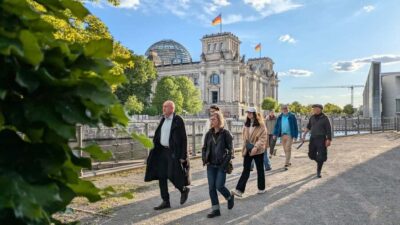
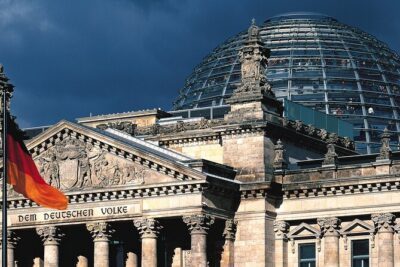
Reichstag Building and the Foster dome: Germany’s democracy, up close
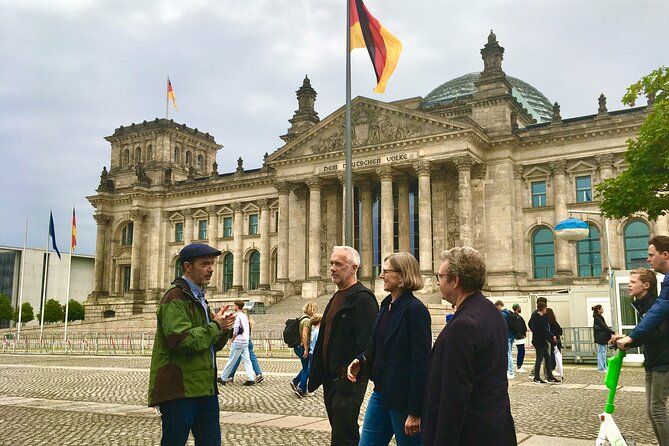
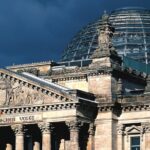
The tour starts at the Reichstag Building, the meeting place of Germany’s Bundestag (the federal assembly, lower house of the national legislature). This is a good first stop because it gives you a clear starting frame: Berlin isn’t just a city of monuments—it’s also a city of political institutions.
What I like here is the contrast between old and new. The Reichstag’s famous glass, transparent dome was added by Norman Foster in the 1990s. Your guide uses that modern architectural statement to point you toward what Berlin is aiming for now: democratic government, shown in a highly visible way. You’re not stuck staring at a single facade either. You’ll get a quick, guided sense of how the building functions within Germany today.
Practical note: the listed stop time is short, about 15 minutes. That’s not a problem if you treat it like orientation—get your bearings, then move on while the story stays fresh.
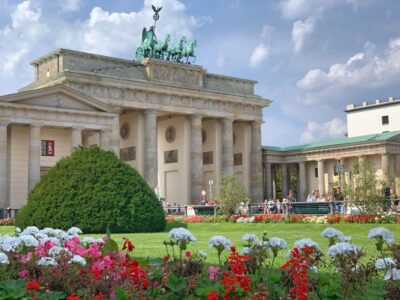
Brandenburg Gate: from Prussian kings to Cold War memory
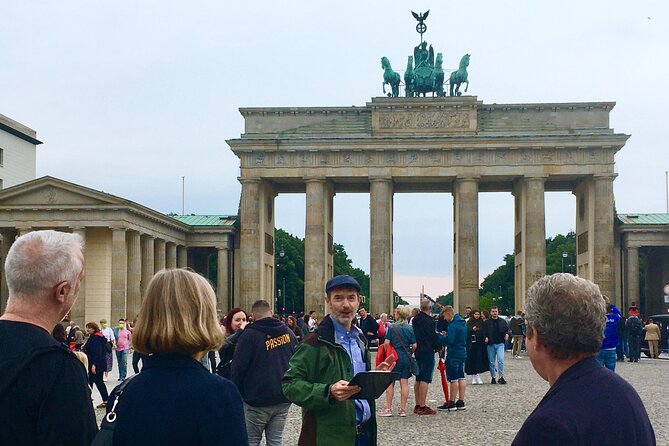
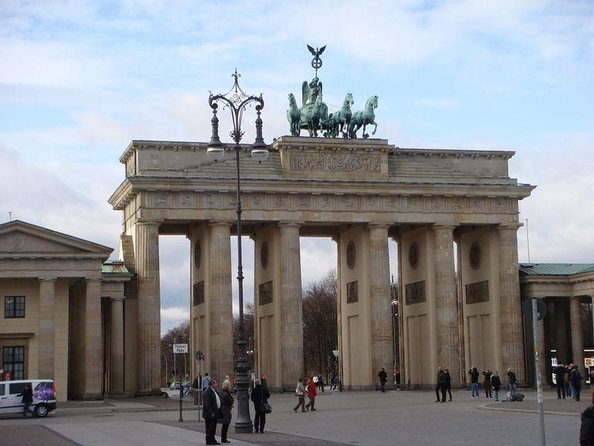
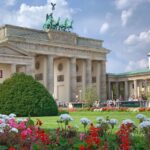
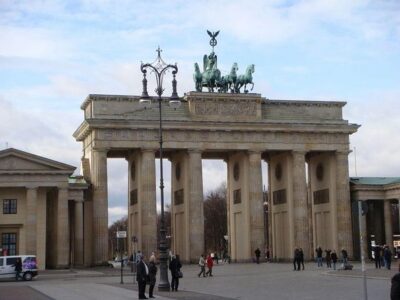
Next comes the Brandenburg Gate, an 18th-century neoclassical monument built on orders of Prussian king Frederick William II. It’s the kind of sight that can feel familiar from photos, but a guide can make it feel newly specific—because it’s not just a landmark. It’s a stage.
Your guide ties the gate to major moments that people associate with Berlin’s political shifts. You’ll hear about Napoleon’s triumphant entrance and Ronald Reagan’s Cold War speech—two very different eras, both anchored at the same spot. That connection matters because it shows how Berlin’s symbolism gets reused, reinterpreted, and reloaded with meaning depending on who’s in power and what the world is tense about.
This stop is about 20 minutes and has free admission. Use the time to look past the obvious angles. If you’re an architecture fan, you’ll probably find yourself noticing symmetry and scale more once you know who originally commissioned it and why.
Museum Island’s big-name museums without museum-day overload
Then you roll into Museum Island on Spreeinsel (Spree Island). This area is all about concentrated culture: five large Berlin museums built under Prussian rulers. On this walk, you’re given the key names so you can decide if you want to come back later for deeper exploring.
The highlights you’ll hear about include the Pergamon, the Neues Museum (New Museum), and the Alte Nationalgalerie (Old National Gallery). Even if you don’t go inside during the tour, the guided viewpoint helps you understand why this cluster matters: it wasn’t “just” cultural building projects. It was part of a broader Prussian-era approach to shaping how people learned, gathered, and remembered.
The stop is around 25 minutes, with free admission noted for the itinerary. That makes it a smart breather between heavier political stops. It also helps you spot the museum district quickly, so you don’t feel lost later.
One drawback to keep in mind: Museum Island can make you want more time than the tour allows. If you’re the type who hates leaving before you fully explore, plan to return on a separate day.
Potsdamer Platz: the Wall’s shadow and the square’s restart
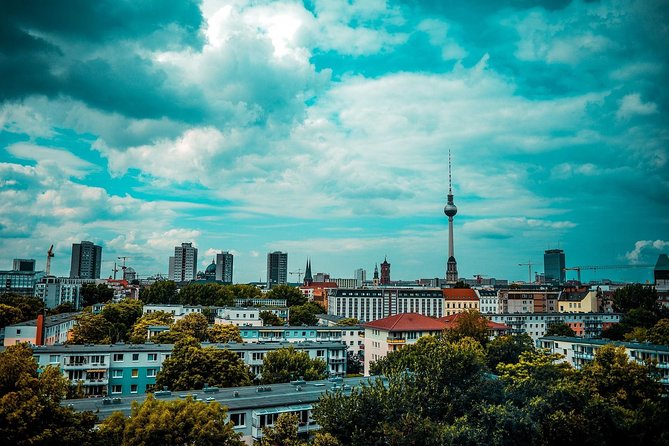
Potsdamer Platz is a different kind of Berlin. This is where the story shifts from power and institutions to a modern urban hub that was reborn after the fall of the Berlin Wall. The square today is known for entertainment, restaurants, and shops, but your guide frames it as a “then and now” contrast.
I like how this stop prevents the walk from becoming one long lecture. It gives you a sense of how Berlin reorganized itself spatially after a political rupture. Even if you’re not shopping or eating right there, just seeing the square with that context makes it feel less like a generic city center and more like a planned comeback.
Time is about 15 minutes here. That’s enough for the guided context and a quick orientation scan—especially helpful if you’re going to use the area later in your trip.





Unter den Linden to Tiergarten: grand boulevard to inner-city pause
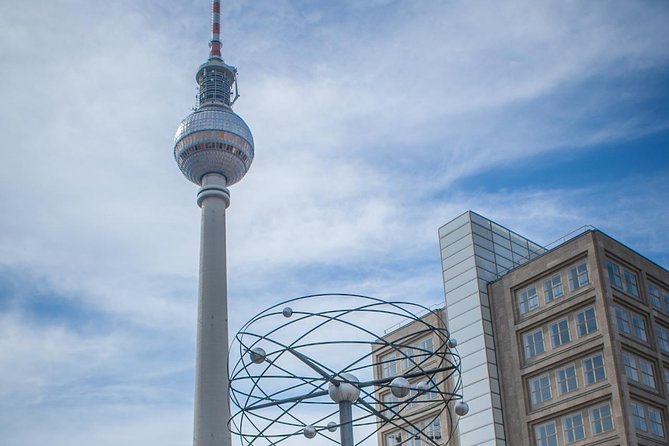
After Potsdamer Platz, you move to Unter den Linden, the grand boulevard running from the City Palace to Brandenburg Gate. The name comes from the linden trees lining the avenue. Your guide also positions it as Berlin’s answer to Paris’s Champs-Élysées, which is a useful comparison for understanding what kind of street this is: a ceremonial spine meant to project order and importance.
This segment is about 30 minutes, so it gives time to notice the boulevard’s scale and the way it pulls you from “institution” to “city life” without losing the storyline. It also helps you understand how Berlin’s major axes connect.
Then you pause briefly at Tiergarten, Berlin’s most famous inner-city park. You get about 10 minutes at this stop, and the goal isn’t a long picnic break—it’s a reset. Tiergarten is described as a park full of gardens and grand statuary, and that matters because it’s part of how Berlin balances formal power with public green space.
Consideration: if it’s a busy day or you’re traveling during peak crowds, this route can feel like a series of fast transitions. The short park stop is still worth it, but don’t expect a full nature moment. Expect a mental breath.
Holocaust Memorial: the walk-in part you should take slowly
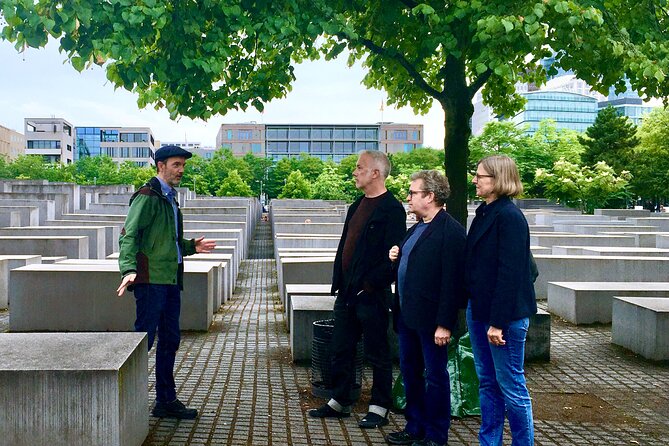
The Holocaust Memorial (Memorial to the Murdered Jews of Europe) is a major emotional stop on this route. It was designed by architect Peter Eisenman and opened in 2005. The design uses 2711 concrete slabs of different heights, creating a powerfully somber labyrinth and a space for reflection.
This is one place where I think “fast tour pace” can be the wrong approach, even when the itinerary lists about 10 minutes. Your best move is to use your guide’s framing and then slow yourself down when you enter. The site is designed to shape your movement and perception. Trying to rush it can make you miss what it’s trying to do.
Even with a short scheduled stop, the payoff is real: it helps you connect Berlin’s political storytelling to memory and human loss. If your trip includes other Holocaust-related sites, this can also work as a grounding first step.
Hackescher Markt courtyards: pre-war Art Nouveau details at street level
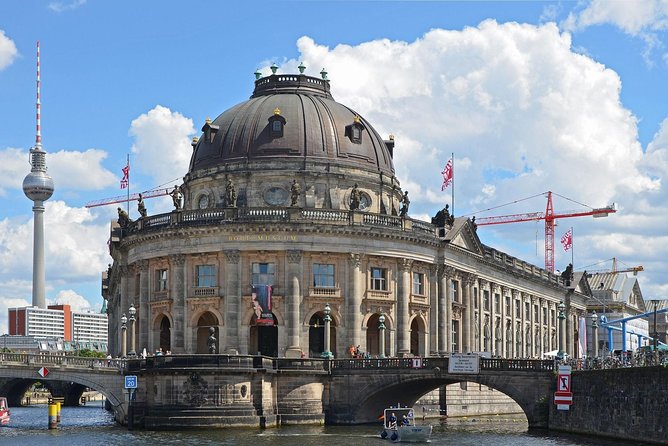
The last stop is Hackescher Markt, a lively square where you get a glimpse of preserved Art Nouveau courtyards from pre-war Berlin. This is where the tour picks up texture. Instead of only monumental views, you get a sense of everyday city architecture—courtyards and street-level rhythms.
The stop is about 15 minutes. That’s enough time to spot the courtyards and understand why the area matters: it’s not just about what Berlin replaced after the 20th century. It’s also about what survived, and how the city holds onto craft details even when the political story changes.
If you like neighborhoods that feel lived-in, this ending helps. It’s also a good setup for continuing your day in a place with plenty to do, even if you don’t plan anything fancy.
What you actually get in 3 hours for $156.53

Let’s talk value, because $156.53 per person is not pocket change. The pricing makes sense only if you’re getting more than “a walk past famous buildings.” Here’s what you’re buying:
- A 3-hour tour with a historian. That’s the core value: interpretation, not just visuals.
- Small group size (max 8). Fewer people means your guide can respond and keep the story cohesive.
- Free entry at the listed stops. The itinerary’s featured sights are marked as free, so you’re not paying admission on top of the tour price.
- Mobile ticket and English-speaking guide experience. You get convenience in the booking-to-day-of flow, and language access is clearly listed.
If you do quick math, you’re paying about $52 per hour for guided, historian-led explanation. For many visitors, that’s comparable to (or better than) the cost of piecemeal museum entry plus a guide—especially since the route spans multiple major landmarks, all within about 3 hours.
One more practical detail: the tour is usually booked around 7 days in advance on average. That doesn’t mean you must rush, but it does mean you should check availability sooner rather than later if your dates are fixed.
Getting around efficiently: transit hops and a day pass check
This walking tour is set up for coverage, not for zero transit. Distances between some key sites would be too far to walk straight through, so you’ll use public transport a few times.
If you don’t already have a Berlin visitor transit pass, the guidance is to consider a day metro pass. The provided ticket info includes:
- One-way AB ticket: 2.8 EUR
- Day ticket for one person: 7 EUR
- Senior discounts are listed for both (AB one-way: 1.70 EUR; day ticket: 4.70 EUR)
Your guide can help you buy a pass at the first metro station if you can’t purchase in advance. That’s a helpful safety net, especially if you’re arriving on a tight schedule.
Tip for planning: since the start is at Unter den Linden 42 (10117 Berlin), think about how you’ll reach that area early. The tour is near public transportation, so you should be able to get there without too much hassle.
Guide style: why a small group feels different here
The tour is run by Insight Cities, and the people leading you include professors, doctoral students, journalists, and enthusiastic local hosts. That mix matters because you’ll likely get more than one communication style: classroom clarity, journalist-level question answering, and host energy.
Also, this is a group-limited experience (maximum 8 travelers). In practical terms, that means the guide can keep momentum without losing people. It also means you can ask follow-ups when something clicks—especially on architecture and political symbolism.
One particularly praised aspect you’ll want to look for is the guide’s architecture-minded approach. In at least one case, an architect named Dan led the group with a pace that covered a lot of ground, and the tour ended with a personal lunch suggestion at an Italian restaurant. That’s the kind of added value you feel on the ground: not just facts, but guidance for your next move.
Should you book this Berlin walking tour?
Book it if you want a tight, coherent storyline connecting Berlin’s political architecture, Prussian roots, Berlin Wall–era context, and memory space—all in about 3 hours with a historian. It’s also a strong pick if you care about buildings and symbolism and you like small groups where you can ask questions.
Skip or reconsider if you hate transit hops and prefer a slow, pure walking loop. Also, if you plan to spend lots of time inside major museums, you may find the museum stop brief. But that’s easy to solve: treat this as the guided “map with meaning,” then return later on your own to the places you want to linger.
If you want an efficient first bite of Berlin that doesn’t just show you landmarks, this tour is built for that job.
FAQ
How long is the Berlin walking tour?
It’s approximately 3 hours.
What is the group size for this tour?
The tour has a maximum of 8 travelers.
What language is the tour offered in?
The tour is offered in English.
Where does the tour start and end?
It starts at Unter den Linden 42, 10117 Berlin, Germany, and ends in Berlin (the exact end point is listed simply as Berlin).
What’s included in the price?
You get a 3-hour tour of Berlin in the company of a historian, plus a mobile ticket.
Do I need admission tickets for the stops?
The itinerary’s listed stops are marked as admission ticket free.
Will I need public transportation during the tour?
Yes, you will use public transport a few times because some key sites would be too far to walk. A day metro pass is suggested if you do not already have a visitor’s transit pass.
What is the cancellation policy?
Free cancellation is available. You can cancel up to 24 hours in advance for a full refund.
More of Berlin on Foot


More Tours in Berlin


More Tour Reviews in Berlin
Round out your days in Berlin

Walking Tours, compared.
 ★ 4.7Berlin City walk Government District and Places of DemocracyFrom $2948,467 reviews
 ★ 4.9Third Reich & Cold War Guided Walking TourFrom $238,378 reviews
 ★ 4.9Discover Berlin Walking TourFrom $235,998 reviews
 ★ 5.0Berlin’s Best: 2 Hour Walking Tour Third Reich and the Cold WarFrom $245,486 reviews
 ★ 4.8Hidden Backyards Guided Walking TourFrom $235,360 reviews
 ★ 5.0Third Reich Berlin: Hitler and WWII Walking TourFrom $243,301 reviews
 ★ 4.9Third Reich, Hitler, and WWII Walking TourFrom $191,757 reviews
 ★ 4.6Alternative Berlin Walking TourFrom $291,204 reviews
Browse the lists this tour appears in