
REVIEW · BERLIN WALL & COLD WAR
Berlin Wall and Cold War Bike Tour in Small Groups
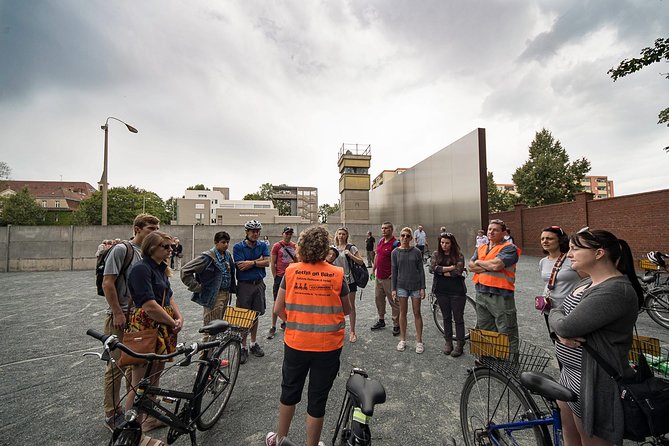
Pedal the Wall without the museum fatigue. This small-group Berlin Wall bike tour strings big landmarks together with the human stories of the border years, and you’ll roll with bike and helmet support instead of walking it all.
My favorite parts are how practical the route feels and how the guide connects each stop to daily life in East and West. One catch: there’s no food or drinks included, so you’ll want to handle a quick snack and water on your own.
In This Review
- Key takeaways before you book
- Why this Berlin Wall bike tour feels like the right size
- Pricing: what $43.54 buys you (and what it doesn’t)
- Your 3.5-hour route: what you’ll see and why it matters
- Brandenburg Gate: the classic landmark that anchors your bearings
- Memorial of the Berlin Wall: where the border’s cost becomes real
- Mauerpark: the Wall’s old border line turned into public space
- KulturBrauerei and the start/end hub: industrial architecture near the route
- GDR watch tower at Kieler Eck: the border-era look-out
- Checkpoint Charlie and Tear Palace: the border crossing you can picture instantly
- The guide makes or breaks this kind of tour
- Cycling comfort: easy enough, but don’t ignore the real world
- When biking beats buses and walking
- Best fit: who will love this tour
- Should you book it? My take
- FAQ
- Is the tour in English?
- How long is the Berlin Wall and Cold War bike tour?
- What is included in the price?
- Where does the tour start?
- Is admission free at the main stops?
- What happens if the weather is bad?
Key takeaways before you book
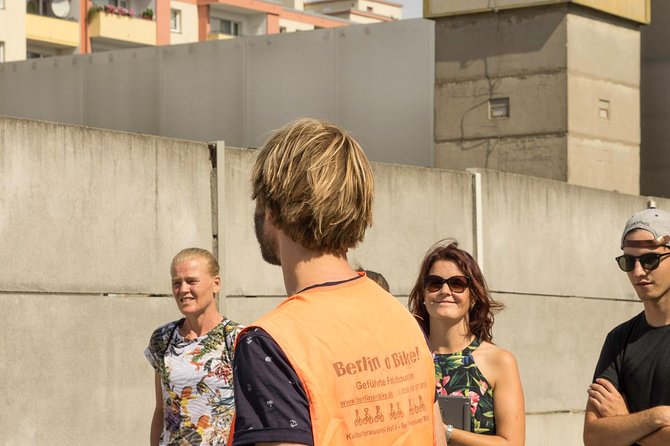
- Max 15 people keeps the tour personal and easy to ask questions
- Big-photo spots on a bike: Brandenburg Gate, Checkpoint Charlie, and more in one smooth run
- Cold War context at street level: you’re riding the geography, not just reading about it
- Stop mix is both symbolic and practical, including the Wall Memorial and a GDR watch tower
- Family-friendly pacing works well for kids and teens when paired with great storytelling
More of the Wall and the divided city
- Berlin’s Best: 2 Hour Walking Tour Third Reich and the Cold War★ 5.0 · 5,486 reviews
- Skip-the-Line: Berlin Wall Museum at Checkpoint Charlie★ 4.1 · 2,041 reviews
- Berlin: East Side Gallery Spree Cruise in a Solar Catamaran★ 4.1 · 1,086 reviews
- Cold War, Berlin Wall, Spies and the East Side Gallery★ 5.0 · 1,024 reviews
Why this Berlin Wall bike tour feels like the right size
Berlin can be information overload. This tour is a focused, short push—about 3 hours 30 minutes—so you get a strong sense of the city’s divide without spending your whole day in transit and queues. I like the structure because it’s not just a list of famous sites; it’s a guided ride that helps you connect the dots while you’re still moving through the real streets.
The small group limit (15 max) matters more than you might think. In a group, you can hear the guide, and you can stop where it’s useful to stop—quickly, safely, and at good viewing points. That also makes it easier for families (and yes, teens) to stay engaged, since you’re not stuck listening for long stretches with nothing changing.
The tour is built for convenience, too: it starts and ends at the same meeting point near Kulturbrauerei (Knaackstraße 97), and the route is designed around iconic Berlin border-adjacent locations.
Pricing: what $43.54 buys you (and what it doesn’t)
At $43.54 per person, this is priced like a solid city activity: you’re paying for a local guide, plus bicycle and helmet use. That’s the heart of the value here. Instead of spending money on transit or renting a bike yourself, you show up, get geared up, and spend your time on the route itself.
What you shouldn’t count on: food and drinks are not included. The stops are short, and while you will likely get guidance that can help with finding places nearby, you’ll still want to be the one managing snacks and water.
Also note what’s not included: there’s no hotel pickup/drop-off, so plan to reach the start point on your own. If you hate navigating transit, this matters—but if you’re okay with getting to a central meeting spot, it’s straightforward.
Your 3.5-hour route: what you’ll see and why it matters
Below is the stop sequence you’ll experience, with what each one is good for and the small practical gotchas to keep in mind.
Brandenburg Gate: the classic landmark that anchors your bearings
You start at Brandenburg Gate, the early classicist triumphal gate on the western flank of Pariser Platz in Berlin’s Mitte district. This is a smart first stop because it’s instantly recognizable—even if you don’t know Berlin’s layout yet.
Why it helps on a bike tour: it gives you a visual centerline. Once you’ve got the Gate in your mental map, the rest of the route makes more sense. You’re not just hearing about the Wall; you’re watching how the border era shaped the city around this monumental point.
Practical note: the stop is brief (around 10 minutes) and admission is listed as free, so it’s a quick orientation moment more than a long sightseeing block.
More of Berlin by bike


Memorial of the Berlin Wall: where the border’s cost becomes real
Next is the Memorial of the Berlin Wall, set up to commemorate the division of Berlin and the deaths at the Wall. This is the emotional anchor of the tour.
Why I think it works here: it’s not buried inside a museum. You’re outside, surrounded by the same kind of streets where border life unfolded. That physical context tends to land harder than a slideshow.
The stop is again about 10 minutes and listed as free admission. Since time is limited, expect the guide to focus on key facts and human stories rather than long reading.
Mauerpark: the Wall’s old border line turned into public space
You’ll ride by Mauerpark, a park whose name traces back to the Berlin Wall erected in 1961. This park sits on the former border between areas including Prenzlauer Berg and Wedding, and it’s described as the border between those districts and areas like Gesundbrunnen.
This stop is one of the best examples of what biking adds. On foot, you might treat a park like a place to rest. Here, it becomes a reminder that the Wall’s line cut right through everyday geography—and later, that geography was reclaimed.
You’ll spend around 5 minutes here. It’s short, but the location-based meaning is big.
KulturBrauerei and the start/end hub: industrial architecture near the route
At the meeting area you’ll spend a moment at Berlin on Bike – Tours & Rental at the Kulturbrauerei bike depot. Then you’ll also pass KulturBrauerei, a preserved 25,000 m² ensemble of buildings with courtyards and historic industrial architecture dating to the end of the 19th century (listed building since 1974).
This is useful for two reasons:
- It confirms you’re starting from a lively, central zone rather than an empty roadside.
- It gives you a quick contrast: Berlin isn’t frozen in the 1980s. It repurposes old structures into modern life.
Time here is short (about 5 minutes), with free admission listed.
GDR watch tower at Kieler Eck: the border-era look-out
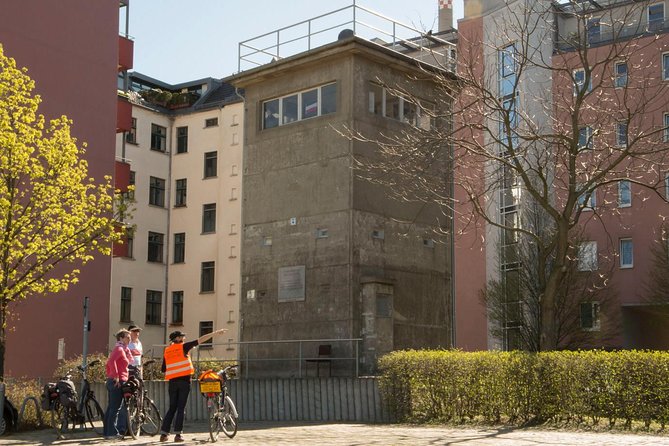
You’ll also visit an old GDR watch tower at Kieler Eck (listed as included). This is a great stop for understanding how surveillance shaped life around the border.
Even if you only see the tower from street level, it changes the way you think about the Wall. Instead of viewing it as one wall segment, you start picturing the system: observation, control, and the anxiety that came with it.
This part is brief (around 5 minutes), but the included stop time usually hits hard because watch towers are visual. You don’t need to read much to understand the purpose.
Checkpoint Charlie and Tear Palace: the border crossing you can picture instantly
Later you’ll reach Checkpoint Charlie, one of the famous crossings through the Wall between 1961 and 1990. It connected Soviet and American sectors in Friedrichstrasse between Zimmerstrasse and Kochstrasse, linking East Berlin (Mitte) with West Berlin (Kreuzberg).
Close behind that is the Tear Palace, the colloquial name for the former exit hall at Bahnhof Friedrichstraße during the divided-city years (between 1961 and 1989).
This combo is powerful because it moves you from:
- the general idea of division (Wall Memorial, geography), to
- the specific experience of crossing, waiting, and separation (Checkpoint Charlie and Tear Palace).
Practical consideration: these are high-impact places with lots of attention in Berlin. You’ll be grateful for a guide who can point out what to focus on—otherwise it’s easy to get distracted by the obvious and miss the meaning.
The guide makes or breaks this kind of tour
This is one of those tours where the bike is only half the story. The best reviews put the spotlight on the guides and their ability to make history feel human.
I saw repeated praise for guides including:
- Peter (Liverpool Pete) for compassion, passion, and guiding people to see the past from multiple angles. He’s also noted for sharing helpful lunch ideas.
- Giovanni for weaving dates and facts into stories about life and struggles across East and West Berlin.
- Monti and George for kindness and clarity—one reviewer even described it like having a useful historical guide that still feels engaging.
- Gilles for enthusiastic storytelling, with strong subject command.
What that means for you: if you care about the human side of the Cold War—not just dates—you’ll get more out of this tour. And if you’re bringing a family, the guide style matters. The tour format is built to keep energy moving between short stops, but a strong storyteller turns those short stops into real understanding.
Tip for your own experience: bring questions. This kind of tour thrives when you ask things like how daily routines changed, what people feared, or what border life looked like beyond the famous photos.
Cycling comfort: easy enough, but don’t ignore the real world
You do get bicycle and helmet included. That’s the obvious comfort win. But I’d also treat this as city biking, not a park ride.
Here’s what you can plan for without overthinking it:
- Wear something you can move in, since you’re stopping and starting.
- Bring a rain layer or wind protection if the forecast looks iffy. The tour says it operates in all weather conditions and also notes that poor weather can trigger changes. Either way, you’ll want to be prepared.
- If you’re coming with kids or teens, pick a calm riding mindset. The guide will control the pace and regroup points, but you still have to be mentally ready for street biking.
One practical note from feedback: the tour is short, and while stops are scheduled, some people wanted a bit more help on where to handle breaks for refreshments or bathrooms. If that’s important to you, I’d plan to handle a quick stop before the tour starts, so you’re not thinking about it while learning.
When biking beats buses and walking
This is where the tour earns its spot on your itinerary.
A walking tour can be slow—great for neighborhoods, but you can lose time and energy. A bike tour solves a key Berlin problem: distance and context. You move fast enough to cover multiple symbolic sites in one go, but slowly enough to stop, look around, and hear the story tied to that exact location.
It also helps you learn Berlin’s shape. Once you’ve ridden between a triumphal gate, a Wall memorial, a park marking the border line, and a crossing point like Checkpoint Charlie, Berlin starts making sense spatially.
That matters later, when you’re exploring on your own. You’ll have a mental framework you didn’t have the first day.
Best fit: who will love this tour
This tour is a good match if:
- You want the Cold War story without spending a whole day on the subway.
- You enjoy learning through place—not just through facts.
- Your group includes different ages, since the pacing and story style can work for both adults and kids.
It may be less ideal if:
- You’re not comfortable cycling in an urban setting.
- You expect a tour that includes lunch or long rest breaks. It’s short and focused, so you’ll manage food on your own.
Should you book it? My take
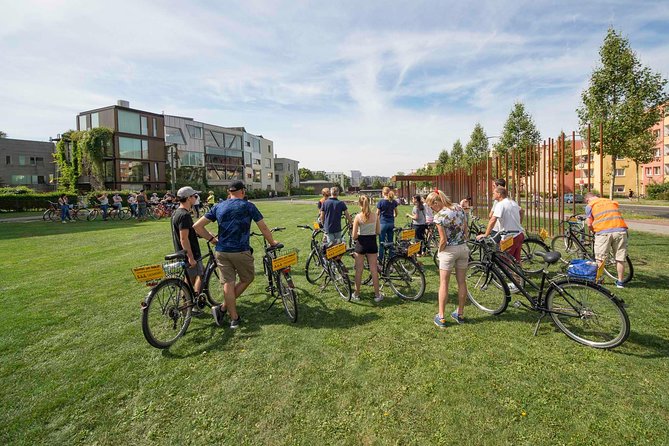
If your goal is to understand the Berlin Wall era with real geography and not just famous names, I’d book this. The small-group size, the included bike and helmet, and the concentration of key sites like Brandenburg Gate, the Wall Memorial, Mauerpark, Kieler Eck’s watch tower, and Checkpoint Charlie with Tear Palace context give you a lot of learning per hour.
Go ahead and book if:
- you want an efficient, memorable introduction to the Wall’s story,
- you like guides who bring personal, human details into the conversation,
- you’re comfortable biking for a few hours.
Skip or look for a different format if:
- you need food included,
- you don’t feel good about city cycling.
Either way, do show up with your own water/snack plan, and you’ll feel in control of the one thing the tour doesn’t provide.
FAQ
Is the tour in English?
Yes. The experience is offered in English.
How long is the Berlin Wall and Cold War bike tour?
It runs for about 3 hours 30 minutes.
What is included in the price?
The tour includes a local guide, plus use of a bicycle and helmet.
Where does the tour start?
The meeting point is at Berlin on Bike – Radtouren & Fahrradverleih, Kulturbrauerei, Knaackstraße 97, 10435 Berlin. The tour ends back at the meeting point.
Is admission free at the main stops?
Some stops list free admission, including Brandenburg Gate, the Berlin Wall Memorial, and Mauerpark. The GDR watch tower is marked as included.
What happens if the weather is bad?
The tour says it runs in all weather conditions, but it also notes that if it’s canceled due to poor weather, you’ll be offered a different date or a full refund.
More Tour Reviews in Berlin

Berlin by Bike
The Wall and the Cold-War City
Round out your days in Berlin
Berlin Wall & Cold War, compared.
 ★ 4.9Third Reich & Cold War Guided Walking TourFrom $238,378 reviews
 ★ 5.0Berlin’s Best: 2 Hour Walking Tour Third Reich and the Cold WarFrom $245,486 reviews
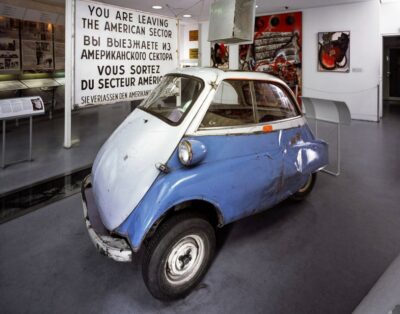 ★ 4.1Skip-the-Line: Berlin Wall Museum at Checkpoint CharlieFrom $212,041 reviews
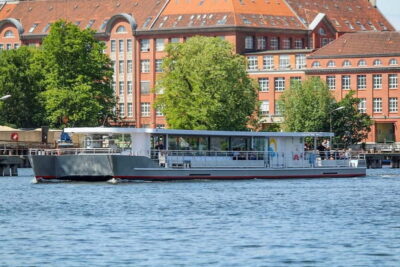 ★ 4.1East Side Gallery Spree Cruise in a Solar CatamaranFrom $281,086 reviews
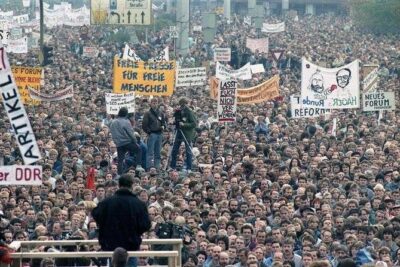 ★ 5.0Cold War, Berlin Wall, Spies and the East Side GalleryFrom $181,024 reviews
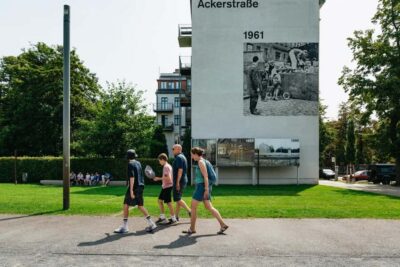 ★ 4.8Wall Tour – Fates, Love Stories, and HeroesFrom $282585 reviews
 ★ 4.5THE WALL: asisi Panorama Berlin TicketFrom $16580 reviews
 ★ 4.8The Wall and Third Reich Guided Bike TourFrom $41578 reviews
Browse the lists this tour appears in