
REVIEW · BERLIN WALL & COLD WAR
Karl-Marx-Allee Tour: Life and Architecture in East Berlin
One street can tell two stories at once. This Karl-Marx-Allee walking tour is a tight, 2-hour way to understand East Germany through the buildings themselves, with an expert local guide who connects design to ideology. I love how the stops stay concrete and visual, from Frankfurter Tor’s symmetry to the 1953 uprising site. I also like the small group size, which keeps the pace friendly. The main drawback: if you want only postcard views and zero politics, this walk will feel heavy at times.
You’ll cover major landmarks along the boulevard with a clear storyline: postwar rebuilding, utopian ideas running into party control, and what changed after the Wall. It runs in English, capped at 15 people, and uses a mobile ticket, which makes last-minute logistics simpler when you’re moving fast around Berlin.
In This Review
- Key highlights I think you’ll care about
- Why a guided walk makes Karl-Marx-Allee click
- Price and timing: getting the highlights fast
- Route basics: starting at U Frankfurter Tor and ending by Strausberger Platz
- From Frankfurter Tor’s symmetry to Laubenganghäuser’s rejected utopia
- Hochhaus an der Weberwiese: luxury, prototype status, and propaganda
- June 17, 1953 to Café Sibylle: politics you can stand on
- Marx, monuments, and the boulevard after the Wall
- Should you book this tour?
- FAQ
- How long is the Karl-Marx-Allee tour?
- What does the tour cost?
- Is the tour in English?
- How big is the group?
- Where does the tour start and end?
- Is a ticket included, and is it digital?
- Are there entrance fees at the stops?
- Do I need to bring anything for the booking?
- Is the tour run in all weather?
- What’s the cancellation window?
- Are service animals allowed?
Key highlights I think you’ll care about
- A real architectural + political storyline (not just dates and facts)
- Small group of max 15, so questions don’t get swallowed
- Stops with free admission, so you’re not paying again and again
- Multiple architects explained in context, including Herman Henselmann and Hans Scharoun
- One uprising location you can stand on, tied to June 17, 1953
- Café Sibylle and the Stalin connection, showing how power showed up in daily life
More of the Wall and the divided city
- Berlin’s Best: 2 Hour Walking Tour Third Reich and the Cold War★ 5.0 · 5,486 reviews
- Skip-the-Line: Berlin Wall Museum at Checkpoint Charlie★ 4.1 · 2,041 reviews
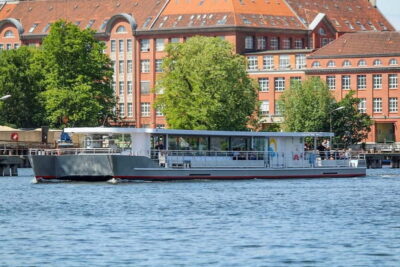
- Berlin: East Side Gallery Spree Cruise in a Solar Catamaran★ 4.1 · 1,086 reviews
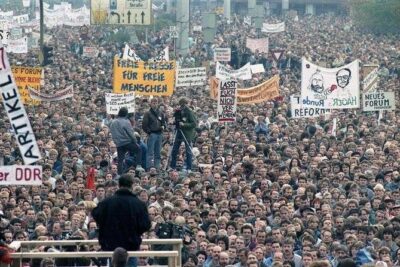
- Cold War, Berlin Wall, Spies and the East Side Gallery★ 5.0 · 1,024 reviews
Why a guided walk makes Karl-Marx-Allee click
Karl-Marx-Allee can look like one long stage set if you wander it alone. A guide changes that fast. You start seeing how the East German state used architecture as a message system: block after block, monument after monument, all meant to shape how people felt about the new socialist future.
What I like most is the tour’s cause-and-effect way of thinking. You don’t just learn that buildings were planned in the early 1950s or that architects had ideas. You hear what those ideas were trying to do—then what happened once politics took the steering wheel. The result is a street that reads like a timeline of hopes, compromises, and control.
And yes, the story includes the darker chapters, including Stalin’s influence and a mass uprising in 1953 that nearly shook the socialist government. But the tour doesn’t stop at shock value. It keeps pulling you back to what you can point at in front of you.
If you like architecture that comes with context—why it was built, who it was built for, and what it was supposed to prove—you’ll find this walk especially rewarding. If you mostly want neutral sightseeing with minimal interpretation, you might prefer a lighter, more casual route.
Price and timing: getting the highlights fast
At $30.01 per person for about 2 hours, this is priced like a focused city lesson rather than a long museum day. For me, the value comes from the density: you cover seven major stops along Karl-Marx-Allee and don’t just skim them. The guide’s job here is to make each location “click” with a specific point—rebuilding programs, propaganda, rejected utopian planning, and post-Wall change.
This also fits the reality of Berlin travel. If you have a tight schedule, Karl-Marx-Allee is one of those areas where a self-guided stroll can feel slow and confusing. A guided walk helps you get your bearings fast and saves you from having to research every façade on the fly.
One more practical plus: the tour is limited to 15 travelers, so it doesn’t turn into a shuffle through history. The pace feels workable, and with only seven stops you’re not constantly rushing to catch up.
The only timing consideration is that it’s a walking tour outdoors. If weather is rough, the tour expects good conditions.
Route basics: starting at U Frankfurter Tor and ending by Strausberger Platz
The walk starts at U Frankfurter Tor (10243 Berlin). That’s a handy launch point because it’s tied to public transport, and it keeps you from needing to map your way across the city on foot.
You’ll finish at Strausberger Platz, near Strausberger Pl. (10 minutes on foot from Alexanderplatz). That matters if you’re building a day around transit hubs. You can wrap this up and then pivot easily to other parts of the city without losing half your day on backtracking.
You’ll also get a mobile ticket, which is useful when your schedule changes. And because the tour is in English with a local guide, you won’t be stuck translating on the move.
The route itself is designed so each stop is short—think in the range of 15 to 20 minutes—enough time to understand what you’re looking at without turning the tour into a lecture marathon.
From Frankfurter Tor’s symmetry to Laubenganghäuser’s rejected utopia
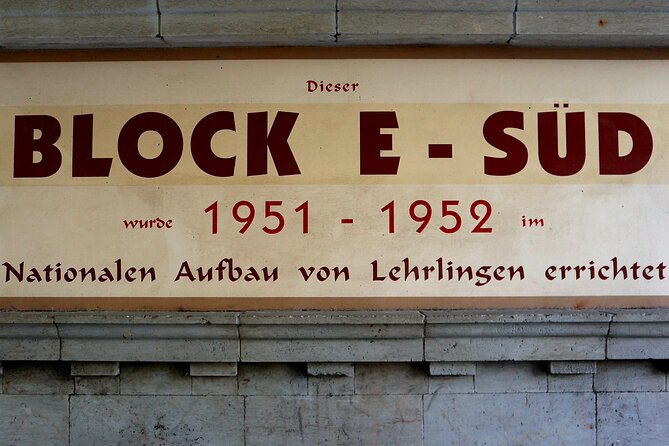
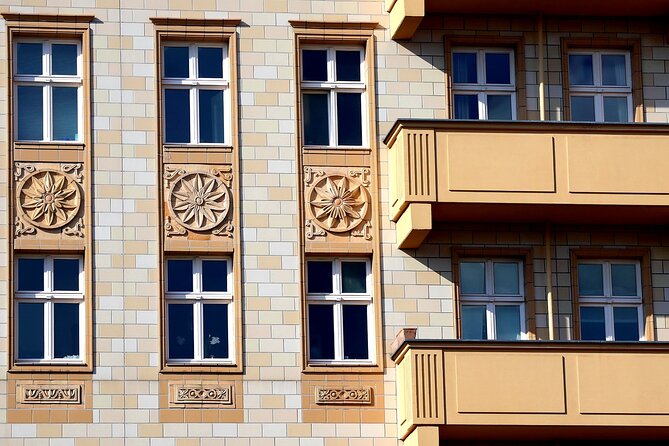
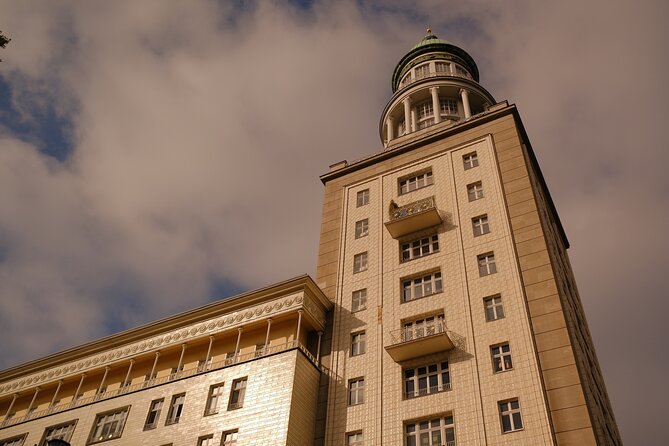
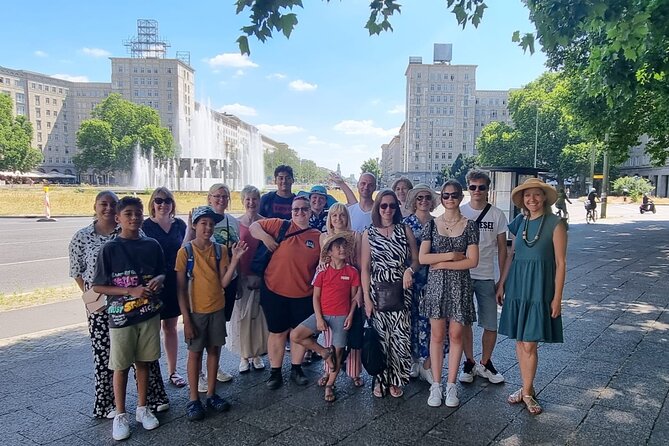
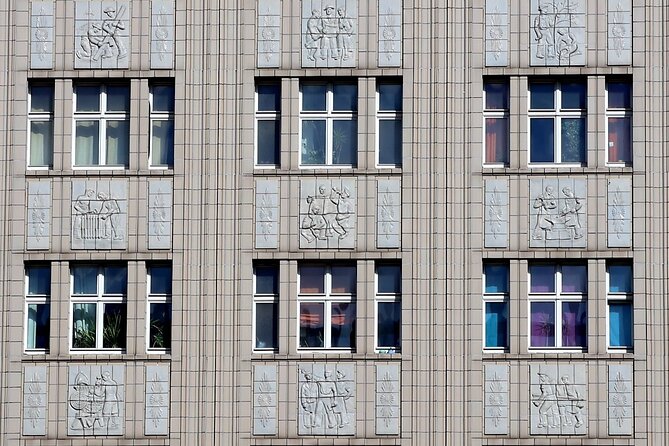
Stop 1 is Frankfurter Tor, and it sets the tone instantly. The towers are known for their symmetry, and the guide uses that visual order to explain how early-1950s planners imagined the first socialist street in Germany. You also hear about the national rebuilding program that mobilized thousands of volunteers—so the architecture isn’t treated like an isolated art project. It’s framed as part of a mass effort with a purpose.
This is the kind of start that helps you read the rest of the boulevard. When you know a place was planned to look a certain way for a reason, you start noticing details you’d otherwise ignore—proportions, repetition, and the sense that everything is designed to “perform” optimism.
Stop 2 is Laubenganghäuser, where the focus shifts to post-WWII modernist architecture by Hans Scharoun. Here’s the key idea: you’re not just seeing buildings. You’re hearing about his utopian urban planning thinking—ideas born from the ashes of destroyed Berlin. Then the tour makes an important point: those ideas didn’t last once the new East German regime tightened its grip. You leave this stop understanding how quickly artistic or social visions can get reshaped by the people holding power.
One practical note: both stops are about what you can observe visually. If you enjoy looking closely at façades and street design, you’ll get more out of these than if you mainly care about landmarks from far away.





Hochhaus an der Weberwiese: luxury, prototype status, and propaganda

Stop 3 is Hochhaus an der Weberwiese, and it’s one of the most interesting because it shows a contradiction. This building was treated as a prototype for the broader socialist Karl-Marx-Allee, and it offered its first tenants an unusual level of luxury for the time. That tension—luxury under socialism—doesn’t get glossed over.
The tour explains how the project became a propaganda tool. The message wasn’t just about housing. It was about demonstrating that the new system could deliver modern, impressive living. And once the state framed it that way, it attracted attention beyond East Berlin.
One of the more telling stories here is the “magnet” angle: Western architects were drawn to the project. That detail matters because it undercuts any simplistic idea that socialist architecture was completely sealed off from outside ideas. Instead, it was a high-profile statement designed to be seen—and debated—even by people who didn’t share the ideology.
If you’re the type of traveler who likes architectural “why,” this stop is a strong one. You’ll probably come away seeing Karl-Marx-Allee as an information channel, not just a neighborhood.
June 17, 1953 to Café Sibylle: politics you can stand on
Stop 4 takes the tour from built ideals to built conflict: Gedenkstätte Arbeiteraufstand 17 Juni 1953. This is where a mass uprising started—disgruntled workers rising in June 1953, at a moment when the socialist government was under serious threat.
The tour also points out that the monument dedicated to the uprising is controversial. That’s an honest detail, and it changes how you read the site. It’s not presented like a clean, one-sided story. It’s presented like a place where history still has friction.
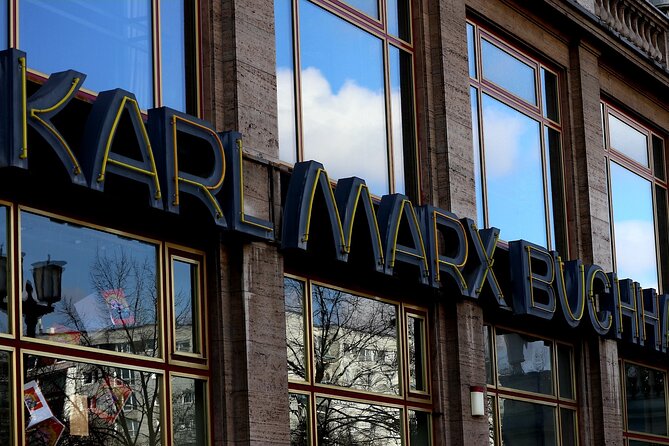
Then you shift to Stop 5: Café Sibylle. This is where the tour turns from monuments to everyday life. You learn how an exclusive café connected with a statue of Joseph Stalin, which stood nearby until 1961. That’s a sharp reminder that politics didn’t live only in government buildings. It showed up in the public space that people used for leisure and conversation.
In other words, you’ll see how power works through symbols, and how those symbols get removed or rewritten over time. The street isn’t only about what was built in the 1950s—it’s about what got replaced later and what that replacement meant.
If you’re sensitive to heavy topics, I’d mentally prepare for this section. It’s not graphic, but it is political, and the tour doesn’t sanitize it.
Marx, monuments, and the boulevard after the Wall
Stop 6 is Karl-marx-bustendenkmal, and it brings the ideology back into focus in a more direct way. You get the name of the author of the Communist Manifesto and learn how socialist ideology shaped everyday life in East Berlin. The point here is interpretation: you’ll understand how abstract ideas translated into routine, institutions, and public messaging.
Then Stop 7 returns you to the present at Strausberger Platz. This section ties the timeline together by looking at what life on Karl-Marx-Allee was like after the Fall of the Berlin Wall and how the area looks and functions today. Even if you already know the broad history, this stop helps you connect the past with what you’re seeing now—because the boulevard is still very much alive as a place people move through.
From a travel perspective, I like the ending because it doesn’t just dump you back at a transit stop. It gives you a final lens: take everything you learned about design and ideology, then watch for the traces of what changed.
Should you book this tour?
I’d book it if you want East Berlin that makes sense fast—especially if you care about architecture with context. This walk is built for travelers who have limited time but still want a strong story: rebuilding efforts, utopian modernism vs. political control, propaganda through housing, and the reality of uprising and power symbols.
I’d skip it (or pair it with a lighter day) if you only want neutral sightseeing. This tour doesn’t hide the political weight of the places it covers, and that’s a feature, not a bug.
If you do book, wear good shoes and bring your curiosity. Karl-Marx-Allee rewards close looking, and a guide helps you see the street the way it was meant to be seen—then helps you understand the rewriting that came afterward.
FAQ
How long is the Karl-Marx-Allee tour?
It’s about 2 hours.
What does the tour cost?
The price listed is $30.01 per person.
Is the tour in English?
Yes, it’s offered in English.
How big is the group?
The maximum group size is 15 travelers.
Where does the tour start and end?
It starts at U Frankfurter Tor (10243 Berlin) and ends at Strausberger Platz on Strausberger Pl., near the roundabout (about a 10-minute walk from Alexanderplatz).
Is a ticket included, and is it digital?
You get a mobile ticket.
Are there entrance fees at the stops?
The stops are listed with admission ticket free.
Do I need to bring anything for the booking?
You’ll receive confirmation at the time of booking.
Is the tour run in all weather?
The experience requires good weather. If it’s canceled due to poor weather, you’ll be offered a different date or a full refund.
What’s the cancellation window?
Free cancellation is available up to 24 hours before the experience start time for a full refund.
Are service animals allowed?
Yes, service animals are allowed.
More Tours in Berlin


More Tour Reviews in Berlin
The Wall and the Cold-War City


Round out your days in Berlin

Berlin Wall & Cold War, compared.
 ★ 4.9Third Reich & Cold War Guided Walking TourFrom $238,378 reviews
 ★ 5.0Berlin’s Best: 2 Hour Walking Tour Third Reich and the Cold WarFrom $245,486 reviews
 ★ 4.1Skip-the-Line: Berlin Wall Museum at Checkpoint CharlieFrom $212,041 reviews
 ★ 4.1East Side Gallery Spree Cruise in a Solar CatamaranFrom $281,086 reviews
 ★ 5.0Cold War, Berlin Wall, Spies and the East Side GalleryFrom $181,024 reviews
 ★ 4.8Wall Tour – Fates, Love Stories, and HeroesFrom $282585 reviews
 ★ 4.5THE WALL: asisi Panorama Berlin TicketFrom $16580 reviews
 ★ 4.8The Wall and Third Reich Guided Bike TourFrom $41578 reviews
Browse the lists this tour appears in