
REVIEW · WALKING TOURS
Love and War in Berlin: Self-Guided Story Puzzle Walk
A phone-led walk turns Berlin history into a game. I like the self-paced format and the way it pushes you to look closely at major WWII-linked sites instead of just passing by. One catch: a few puzzle moments can route you through areas that may get busy at certain times (for example, around seasonal markets), so be ready to make small detours if you need a smoother walk.
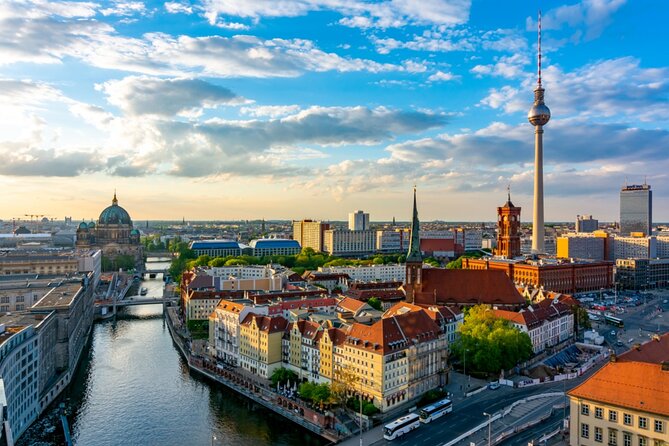
This is designed as a private, no-human-contact experience, roughly 1 hour on foot, and you can start anytime within the listed hours. You’ll use your smartphone as an offline story puzzle, moving from place to place across Berlin’s Mitte district, starting near Alexanderplatz and finishing a bit west near Cora-Berliner-Straße.
In This Review
- Key points to know before you go
- A WWII story you can walk at your own speed
- Price and value: $6 for a guided-feeling experience
- How the phone puzzle works (and why that’s useful)
- Start at Alexanderplatz: getting your bearings with the World Clock
- The walk’s historic backbone: Rathaus and the power of architecture
- Neptune Fountain: a Roman myth in the middle of modern Berlin
- Marx-Engels-Forum: ideology in a public park
- Lustgarten on Museum Island: parade ground energy without the parade
- Neue Wache: Prussian neoclassicism meets a memorial mood
- The walk touches Hitler’s war bunker site area
- Bebelplatz: book burning and the mechanics of intimidation
- Gendarmenmarkt: where uniforms become architecture
- Hamburg in Berlin: state representation as a living street scene
- Memorial to the Murdered Jews of Europe: how to handle it
- Timing your walk: use the flexibility
- Who should book this Berlin puzzle walk
- Should you book Love and War in Berlin?
- FAQ
- How long does the Love and War in Berlin self-guided story puzzle walk take?
- How much does it cost?
- What language is it offered in?
- Can I start at any time during the day?
- Do I need an internet connection to play?
- Is there a physical guide with you?
- Where does the walk start and end?
- What kind of sites will I see?
- Is admission required for the stops?
- Is it private for my group?
- Are service animals allowed?
Key points to know before you go
- Self-guided pace: pause for photos or rest, then pick the story back up
- Offline puzzle play: you don’t need mobile data to do the walk
- WWII focus in central Berlin: you’ll connect the dots across key sites
- Private by design: no guide meeting, fewer crowd pressures
- Smart route length: center-strolling distances without feeling like a forced marathon
- Puzzles with mixed difficulty: some are quick, some make you think a bit longer
More of Berlin on foot
- Discover Berlin Half-Day Walking Tour★ 5.0 · 9,624 reviews
- Berlin City walk Government District and Places of Democracy★ 4.7 · 8,467 reviews
- Berlin: Third Reich & Cold War Guided Walking Tour★ 4.9 · 8,378 reviews
- Berlin: Discover Berlin Walking Tour★ 4.9 · 5,998 reviews
A WWII story you can walk at your own speed

Berlin can be overwhelming if you try to do it like a checklist: one site, one fact, then you sprint to the next. This walk changes the rhythm. Instead of staring at plaques, you solve small challenges that make you look up, look around, and notice details you’d normally miss while chatting or rushing.
The best part is the freedom. You can stop for a coffee, step out of the flow for a few minutes, then rejoin your route. That matters in the center, where street life can change by the hour and by the season. The walk format also helps you take in the emotional weight of places linked to Nazi Germany without turning the visit into a blur.
Price and value: $6 for a guided-feeling experience
At $6 per person, the value is mostly about what you avoid: you’re paying for structure, not for a fancy performance. Instead of hiring a human guide, you get a phone-based story that leads you from landmark to landmark and asks you to participate.
You also get flexibility baked in: the experience is always bookable, and it’s designed so you can start at any hour during the stated window. That’s a real advantage if your Berlin day is already packed with museum tickets or transit plans. With a standard guided tour, you often lose time to group timing. Here, the timing is yours.
How the phone puzzle works (and why that’s useful)
This is offered in English, and it’s set up as a self-guided game. You’ll follow prompts, answer questions tied to what you can see on-site, and advance to the next location.
Two practical benefits:
- No internet needed. You can play offline, which keeps things simpler once you’re in the streets.
- No guide meeting. You won’t spend time coordinating a meetup spot with other people. It’s private for your group, with no human contact, and that also tends to reduce crowd pressure.
If you like city walks where you’re actively solving something, you’ll probably enjoy this more than a straight audio guide. It’s also a good choice if you’ve visited Berlin before and think you know the center already. The puzzle approach often turns familiar streets into a new scavenger hunt.
Start at Alexanderplatz: getting your bearings with the World Clock
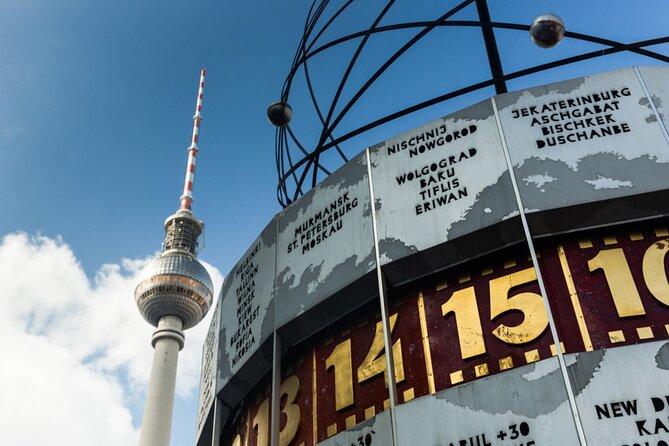
Your walk begins near Alexanderplatz, anchored by the World Clock (Urania World Clock) in the public square.
This is a clever first stop because it gives you an instant orientation tool. The clock is designed to show the time in 148 major cities, and the tower-style design makes it easy to spot from a distance. In a puzzle format, you’re not just looking at a landmark—you’re searching for a specific answer among the markings.
It’s a small thing, but it works: you start with an object that encourages attention to detail. And when you later move into sites tied to power, ideology, and propaganda, that habit of careful looking becomes more valuable.
More guided walks through Berlin





The walk’s historic backbone: Rathaus and the power of architecture
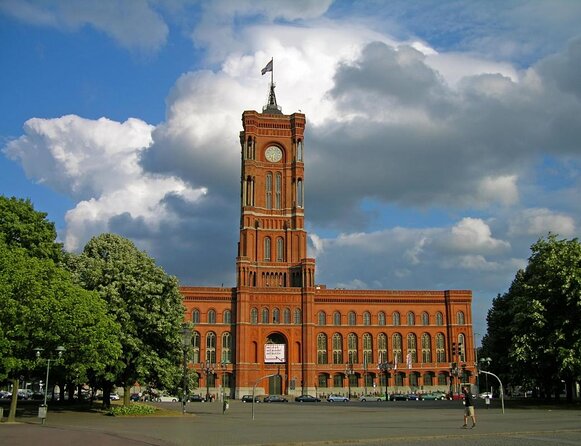
Next you head to Berlin’s Rathaus, built between 1861 and 1869. It’s described in the Northern Italy High Renaissance style, designed by Hermann Friedrich Waesemann. Even if you’ve never studied architecture, you’ll likely feel the message it sends: this building is meant to project authority and permanence.
In this walk format, the Rathaus isn’t just scenery. You’ll look around to find the answer to a challenge that pushes you toward architectural features and design cues. That’s a smart way to read the city. Berlin has layers, and the buildings often say more than the signage.
One practical note: take a breath here. The center can pull you forward, but architecture rewards slow attention. A minute or two of deliberate looking will pay off later when the story shifts from civic buildings to darker chapters.
Neptune Fountain: a Roman myth in the middle of modern Berlin
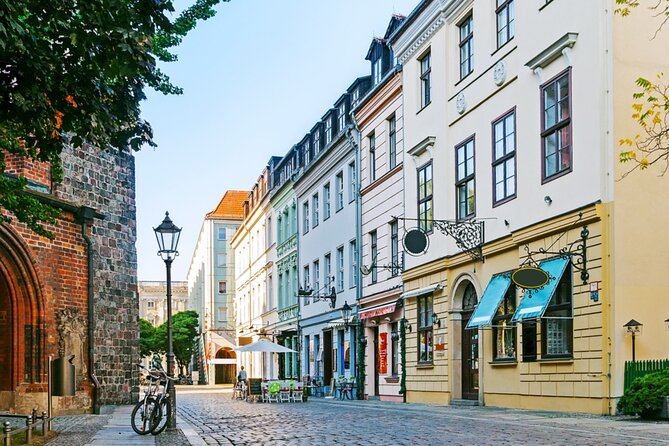
You’ll also pass the Neptune Fountain near Neptunbrunnen, built in 1891 and designed by Reinhold Begas. The Roman god Neptune is at the center.
This stop is useful because it gives your brain a lighter landing between heavy WWII themes. It’s not that the walk avoids the serious stuff—it’s that it spaces out your emotional load. When you come across sculptures and mythology in a place like Mitte, it reminds you that Berlin has had many identities over time.
And yes, it still works as a puzzle stop. The game asks you to look around, so you engage instead of just glancing and moving on.
Marx-Engels-Forum: ideology in a public park
The route then reaches Marx-Engels-Forum, a public park in Mitte created in 1986 by authorities of the former German Democratic Republic (GDR). It’s named for Karl Marx and Friedrich Engels, authors of The Communist Manifesto.
This is where Berlin’s 20th-century story becomes more than a WWII straight line. The DDR era shapes public space and public identity, too. The puzzle format helps you slow down and notice that history doesn’t vanish after 1945—it shifts into new structures, new narratives, and new symbolism.
If you enjoy political history, you’ll likely find this stop especially meaningful. Even if you’re not a politics person, it’s a strong reminder that Berlin’s streets are constantly rewriting themselves.
Lustgarten on Museum Island: parade ground energy without the parade
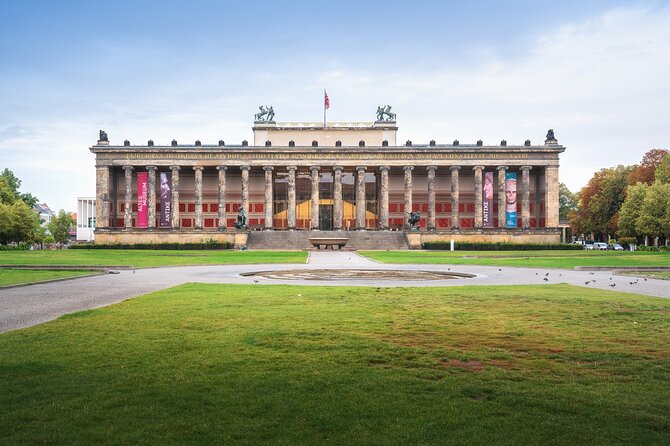
You’ll walk through the Lustgarten, a park on Museum Island near the former Berliner Stadtschloss (Berlin City Palace). Historically, it’s been used as a parade ground, a place for mass rallies, and today it functions as a public park.
That contrast is the point. The same open space can feel celebratory one era and chilling the next. And the puzzle format keeps you from drifting mentally; it nudges you to pay attention to your surroundings rather than turning the walk into background noise.
Try not to speed through this section. Give yourself a couple of minutes to look across the space and imagine how crowds and ceremonies might have moved here in different decades.
Neue Wache: Prussian neoclassicism meets a memorial mood
Then the story brings you to Neue Wache on Unter den Linden. The building was erected from 1816 to 1818, designed by Karl Friedrich Schinkel, and it served as a guardhouse and also a memorial to the Liberation Wars.
In a self-guided puzzle walk, Neue Wache can feel like a pivot point. You’re leaving civic and ideological spaces and entering a more reflective mode. The game challenges you to look closely, which fits the emotional function of the building: this is a place where attention matters.
If you’re sensitive to heavy topics, plan for a slower pace here. You don’t need to race. Stop, read what you can, and take the time your body asks for.
The walk touches Hitler’s war bunker site area
One of the highlights of this experience is that the story connects you to the site of Hitler’s former war bunker. Since the exact in-game location isn’t spelled out in your trip notes here, the best advice is simple: follow the puzzle prompts carefully and don’t treat any segment as optional.
This part can be emotionally intense because it’s tied to what happened during WWII. The puzzle approach helps because it keeps you engaged in the present moment—looking around and answering—rather than just absorbing information passively.
Bebelplatz: book burning and the mechanics of intimidation
Next comes Bebelplatz, known for the infamous Nazi book burning ceremony on 10 May 1933 in evening events in German university cities. The book burnings were hosted by the nationalist German Student Association, with the organizers trying to get ahead of other National Socialist student groups.
This stop is powerful, and it’s also well suited to a puzzle walk because it turns history into something you actively research on-site. Instead of reading a paragraph and moving on, you’re prompted to look for the answer tied to what’s in front of you.
Allow time here for a pause. If you walk straight through without breathing, the emotional weight can hit all at once later. Take a minute now.
Gendarmenmarkt: where uniforms become architecture
From Bebelplatz you head toward Gendarmenmarkt. The square’s name traces back to the “Gens d’armes” cuirassier regiment, whose stables were demolished by Friedrich II. Between the two churches, a theatre was built, now known as the Konzerthaus Berlin.
This is another interesting transition stop. The walk moves from ideology and censorship to a grand public square shaped by state power, military history, and later civic culture. In puzzle form, you’ll likely find yourself taking in angles and details you’d normally ignore when you’re just snapping a photo.
Gendarmenmarkt is also a place where people like to linger. If you like to watch how the city breathes, this is a good area to slow down without getting lost.
Hamburg in Berlin: state representation as a living street scene
The route then passes the state representation of the Free and Hanseatic City of Hamburg in Berlin, located in the classicist town house on Jägerstraße in the government district. The information you get points out that over 500 events and encounters happen each year, and the site hosts everyday political life in the capital.
This stop might seem “lighter” after the WWII chapters, but that’s part of the value. It shows how Germany’s modern institutions occupy spaces shaped by earlier power struggles. Even if you’re not attending an event, simply being in a building that functions as a hub for governance adds context.
The puzzle prompt here keeps it from becoming just a photo stop. You’ll look around and work through the story link before continuing.
Memorial to the Murdered Jews of Europe: how to handle it
Finally, you’ll reach the Memorial to the Murdered Jews of Europe. In 1999, the German parliament chose to establish a central memorial site; the design competition was won by New York architect Peter Eisenman, and it opened in 2005.
This is the kind of site where people often feel unsure how long to stay. With this walk, you don’t have to force a perfect timeline. Use the puzzle moment as a starting point, then stay as long as you need afterward.
Practical tip: wear shoes that can handle longer standing and walking over uneven memorial terrain. Even if the walk is about an hour overall, memorial spaces can invite lingering.
Also, since the walk format keeps you active, it can help you avoid the paralysis that sometimes happens at large memorials. You’ll already be in motion, searching, noticing, and answering—then you can settle into reflection.
Timing your walk: use the flexibility
This experience is listed at about 1 hour. In practice, your time depends on two things:
- how quickly you solve each puzzle
- how often you stop for a photo, a quick drink, or a breather
Because the experience is designed for full flexibility, you can pause and resume. I recommend building in buffer time at least once, probably around Neue Wache or Bebelplatz, where it’s easiest to feel the emotion shift.
The hours listed also matter. The walk window runs from early morning until late evening (Monday through Sunday, 5:00 AM to 9:00 PM). That means you can match it to your Berlin day, whether you’re a morning person or you prefer golden hour streets.
Who should book this Berlin puzzle walk
Book it if you want:
- a private way to explore Berlin’s center without coordinating with a group
- a WWII-focused route that also connects to later German history
- an experience that makes you look at places rather than just read about them
- a phone-based activity you can do offline without hunting for data
It’s also a strong fit for repeat visitors. Even if you think you know Mitte, the puzzle challenges tend to lead you to details and story connections that feel new.
Should you book Love and War in Berlin?
I’d say yes if you like interactive city walking. The $6 price is low enough to feel safe, but the structure is strong enough to feel like a real itinerary. The private format and offline play are practical wins, and the site selection gives you both the civic and the brutal parts of Berlin’s 20th-century story.
I’d think twice if you need a traditional guided explanation with deep historical narration, or if you strongly prefer quiet routes at all times. The format relies on you solving prompts in public spaces, and occasionally that can mean adapting around crowds.
Overall, this is one of those rare deals where you feel you’re doing something, not just moving from point A to point B.
FAQ
How long does the Love and War in Berlin self-guided story puzzle walk take?
It takes about 1 hour on average.
How much does it cost?
The price is $6.00 per person.
What language is it offered in?
It’s offered in English.
Can I start at any time during the day?
Yes. You can start at any hour, and the experience is always available to book.
Do I need an internet connection to play?
No. You can play offline, so you do not need internet connection.
Is there a physical guide with you?
No. It’s a private, no human contact experience.
Where does the walk start and end?
It starts at Alexanderpl. 1, 10178 Berlin, Germany and ends at Cora-Berliner-Straße 1, 10117 Berlin, Germany.
What kind of sites will I see?
You’ll see major landmarks in central Berlin, including WWII-related locations, plus places connected to Nazi history and modern memorials.
Is admission required for the stops?
Some stops list admission ticket free, such as Neptunbrunnen and Bebelplatz, but the tour notes don’t say every stop has the same admission rules.
Is it private for my group?
Yes. It’s listed as a private tour/activity, so only your group participates.
Are service animals allowed?
Yes, service animals are allowed.
More Guided in Berlin

More of Berlin on Foot




More Tour Reviews in Berlin




Round out your days in Berlin

Walking Tours, compared.
 ★ 4.7Berlin City walk Government District and Places of DemocracyFrom $2948,467 reviews
 ★ 4.9Third Reich & Cold War Guided Walking TourFrom $238,378 reviews
 ★ 4.9Discover Berlin Walking TourFrom $235,998 reviews
 ★ 5.0Berlin’s Best: 2 Hour Walking Tour Third Reich and the Cold WarFrom $245,486 reviews
 ★ 4.8Hidden Backyards Guided Walking TourFrom $235,360 reviews
 ★ 5.0Third Reich Berlin: Hitler and WWII Walking TourFrom $243,301 reviews
 ★ 4.9Third Reich, Hitler, and WWII Walking TourFrom $191,757 reviews
 ★ 4.6Alternative Berlin Walking TourFrom $291,204 reviews
Browse the lists this tour appears in