
REVIEW · WALKING TOURS
Rebels & Exiles: A West Berlin Literary Walking Tour
One sentence hook: Berlin’s literature trail isn’t boring. This West Berlin literary walking tour led by Marcel Krueger turns everyday streets into a story about authors, dissent, and the creative scene that grew up around pre-war City West and the rebellious West Berlin years. I love the mix of literary names (Walter Benjamin, Joseph Roth, Kurt Tucholsky) with the real places you can still stand in today. I also like that it is fast-paced and story-driven, and that you’ll get short readings along the way instead of just staring at buildings.
The one consideration: because it is a 2-hour walking route, it moves at a lively pace, so bring comfy shoes and don’t expect lots of long stops for sitting.
In This Review
- Key highlights you’ll feel right away
- A West Berlin Literature Route That Mixes Politics and Pop Culture
- Price and What You Actually Get for $34.30
- Start at Hardenbergplatz: How the 2:00 pm Plan Works
- Europa-Center and the Romanisches Cafe Exhibition Finish
- Stolperstein at Waldorf Astoria Berlin: John Hoexter’s Name on the Street
- George Grosz Plaza: Where Writers Meet Film, Visual Art, and Music
- Walter-Benjamin-Platz: A Square Named for a Philosopher
- Schwarzes Cafe: Iggy Pop and David Bowie in a Literary Context
- Savignyplatz and Kantstrasse Loop: West Berlin Writers of the 1970s and 80s
- HOTEL ZOO BERLIN: How Hotel Writing Echoes Beyond Berlin
- Pace, Atmosphere, and the Small Details That Matter
- Who This West Berlin Literary Tour Suits Best
- Should You Book Rebels & Exiles?
- FAQ
- How long is the Rebels & Exiles: A West Berlin Literary Walking Tour?
- What is the price per person?
- Where do I meet, and where does the tour end?
- What language is the tour offered in?
- How big is the group?
- Is anything included besides the walking tour?
Key highlights you’ll feel right away
- Small group (max 10) keeps the guide’s pace interactive and focused
- Stolperstein stop tied to John Hoexter adds a human, street-level layer to the literature
- George Grosz Plaza connects writers to film, visual art, and music
- Walter-Benjamin-Platz is a thoughtful question about legacy and architecture
- Schwarzes Cafe links literary life to Iggy Pop and David Bowie
- Romanisches Cafe exhibition at Europa-Center ends the walk with included entry
More of Berlin on foot
- Discover Berlin Half-Day Walking Tour★ 5.0 · 9,624 reviews
- Berlin City walk Government District and Places of Democracy★ 4.7 · 8,467 reviews
- Berlin: Third Reich & Cold War Guided Walking Tour★ 4.9 · 8,378 reviews
- Berlin: Discover Berlin Walking Tour★ 4.9 · 5,998 reviews
A West Berlin Literature Route That Mixes Politics and Pop Culture
West Berlin has a reputation for being all concrete, shopping, and straight lines. This tour flips that idea fast. You’ll walk through a stretch of City West where ideas flowed between writers, artists, and musicians, and where politics showed up in daily life—not as a lecture, but as part of the city’s mood.
What I like most is that the tour keeps its feet on the ground. You’re not stuck inside a classroom. Each stop feels like a small scene: a philosopher’s name on a square, a café connected to musicians, a hotel site linked to major publishing and literary styles. That makes the whole route practical. You can look at the streets after the tour and actually understand what you’re seeing.
The tone is also very readable. Marcel tells the stories with a clear narrative arc: from the older City West setting to the rebellious West Berlin writers active in the 1970s and 1980s. That link matters because it reminds you that the literary scene wasn’t just produced by genius—it was shaped by place, limits, and pressure.
Price and What You Actually Get for $34.30
At $34.30 per person for about 2 hours, this is priced like a well-planned neighborhood walk rather than a museum day. The big value point is that admission to the Romanisches Cafe exhibition is included, along with small surprises.
Here’s the practical math: you’re paying for (1) a guided walk with a tight route, (2) outdoor context stops where you’ll hear why each place matters, and (3) one indoor exhibition entry where you get to follow through on the themes. Coffee and/or tea aren’t included, so budget a quick stop either before or after if you want a break.
Group size is capped at 10, which usually means you’re less likely to get lost in the back. That matters for a tour that includes readings. If you want the guide’s words to land, a smaller group helps.
Start at Hardenbergplatz: How the 2:00 pm Plan Works
You start at Hardenbergpl. 11, 10623 Berlin (near public transportation). The tour begins at 2:00 pm and runs for about 2 hours, ending back at the meeting point.
The ending point is important because it affects your expectations. You finish at Europa-Center, at the Romanisches Cafe exhibition area. So rather than ending somewhere with a random view or a quick photo, you end with something you can actually take in.
Most of the stops are quick—think 5 to 10 minutes at each location—so don’t schedule something right after the tour. Give yourself a little breathing room. Also, because the experience requires good weather, plan to dress for whatever Berlin does in the afternoon. Even a short walk in cool rain can feel long.
Europa-Center and the Romanisches Cafe Exhibition Finish
The last stop is where the story lands: Romanisches Cafe in Europa-Center. You’ll wrap up around the exhibition area, with an admission ticket that is free and included.
This ending is more than a bonus. It gives you a place to slow down after the walking, and it ties the tour’s themes to a setting that feels true to the era—cafés as working spaces for ideas, drafts, arguments, and collaborations. Even if you don’t treat the exhibition like a full museum visit, the time helps you connect the name-dropping from earlier stops to a visual and atmospheric frame.
Time-wise, plan for the fact that the exhibition entry will likely take a bit of your energy. If you’re the type who likes to read every label, you’ll want to linger. If you prefer scanning and absorbing the vibe, it still works well as a finish.

Stolperstein at Waldorf Astoria Berlin: John Hoexter’s Name on the Street
The tour’s first literary memory stop is at the Waldorf Astoria Berlin, focused on a Stolperstein for John Hoexter. Stolpersteine are small memorial stones embedded in the street. They force you into a street-level kind of history: not a distant plaque, but a name that you literally step past.
This stop is short (about 10 minutes), but it carries weight. The tour uses it to connect literature and art to real lives and real consequences. It’s a good reminder that the creative world never sits apart from politics. In Berlin, you often meet history before you understand it.
Practical tip: if you’re taking photos, be ready for a stop that’s partly about attention rather than angles. Give your eyes a few seconds on the stone and the surrounding context before you lift your camera.
George Grosz Plaza: Where Writers Meet Film, Visual Art, and Music
Next you move to George Grosz Plaza, another quick stop (about 5 minutes). Even in a short window, this is one of the most “Berlin” moments on the route, because it connects literary work to the broader art ecosystem.
You’ll hear how the area’s artistic legacy spans film, visual art, and music. That’s a useful lens if you tend to think of literature as only books on a shelf. In West Berlin, the creative scene often shared spaces, shared audiences, and shared frustrations. Art forms braided together.
This stop is also a strong reset point. After the solemnity of the Stolperstein, you get back to energy and culture—less about mourning, more about how ideas spread.
Walter-Benjamin-Platz: A Square Named for a Philosopher
At Walter-Benjamin-Platz, the tour slows just enough (about 10 minutes) to make a point. You’ll hear about legendary philosopher and writer Walter Benjamin, and then—importantly—about why the architecture of the square named after him does not perfectly represent his legacy.
That angle is smart for two reasons. First, it makes you think instead of just memorize. Second, it helps you spot a common Berlin pattern: monuments and naming can tell a story, but the real story is often messier.
If you like ideas that challenge the neat version of history, you’ll enjoy this stop. It gives you a framework you can use later while exploring Berlin on your own.
Schwarzes Cafe: Iggy Pop and David Bowie in a Literary Context
Schwarzes Cafe is one of the most pop-culture-friendly parts of the route, without losing the literary focus. The stop lasts around 10 minutes, and you’ll learn about it as a legendary haunt connected to Iggy Pop and David Bowie.
This is a great moment if you want your Berlin to have edge. It also helps you see how the late-modern cultural scene kept talking back to earlier intellectual traditions. Even if you’re more of a music fan than a classics reader, this stop gives you an entry point.
A practical note: cafés are places where people talk over each other. This tour is guided, so expect the guide’s voice and pacing to shape what you notice. If you want the exact wording of a point, stand where you can hear.
Savignyplatz and Kantstrasse Loop: West Berlin Writers of the 1970s and 80s
After Schwarzes Cafe, the tour loops back toward Bahnhof Zoo via Savignyplatz and Kantstrasse, with a shorter stop around 5 minutes. This part is about mapping the West Berlin writer scene of the 1970s and 1980s.
The way this works is useful: rather than treating writers as isolated figures, you learn how they connected to a neighborhood’s rhythm. Savignyplatz and Kantstrasse aren’t famous for one specific author in the way a statue might be. Instead, they help you understand the broader ecosystem—where writers could be active, gather, publish, and argue.
This is also where a strong guide really matters. The route is familiar urban scenery unless someone gives it an intellectual storyline. Marcel does, and it changes your reading of the street.
HOTEL ZOO BERLIN: How Hotel Writing Echoes Beyond Berlin
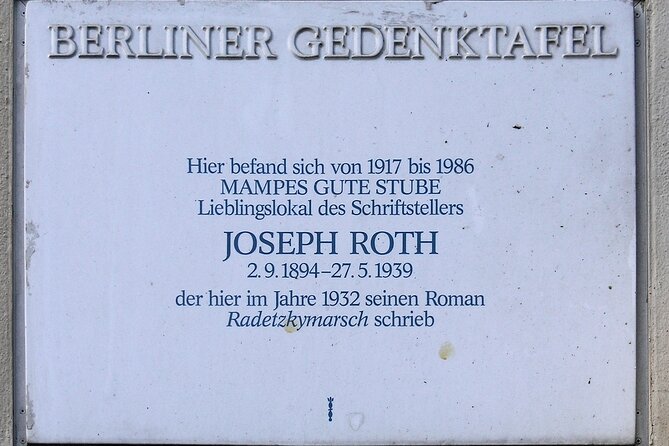
The final “anchor” stop is Hotel Zoo Berlin (about 5 minutes). Here, the tour focuses on how hotel writing connects to Weimar and world literature, using Joseph Roth and Vicki Baum as examples.
Even though the stop is brief, the concept is big. Hotels are transitional spaces: people arrive, disappear, and reshape each other’s lives. That makes them perfect settings for literature that follows movement, displacement, and social shifts.
This is also a satisfying way to end thematically. The earlier stops cover named intellectuals and cultural legends. Hotel Zoo adds a different kind of lens: how a place type can shape writing, not just the name attached to it.
Pace, Atmosphere, and the Small Details That Matter
This tour runs in a way that feels designed for attention. Stops are short, transitions are quick, and the guide keeps the narrative moving. That matches the topic: literary scenes often change fast, even when the themes—freedom, identity, politics—keep returning.
One detail I value is that the guide does more than summarize. You’ll hear short readings from the work connected to the places you’re standing in. That turns the walk into something closer to a live performance of ideas. It also helps you understand tone, voice, and style, which is hard to get from a quick street explanation alone.
The tour is offered in English, and it’s built for people who want a mix of politics and culture without heavy academic baggage. If you enjoy places where art and dissent meet, you’ll probably have a strong time.
The only real “watch out” is physical. It’s a walking tour with multiple quick stops. If you prefer slow museum pacing, bring patience for a more kinetic format.
Who This West Berlin Literary Tour Suits Best
This tour fits best if you fall into one (or more) of these categories:
- You like literary history tied to real neighborhoods, not only big landmarks
- You enjoy the links between writers, visual art, and music
- You like guided reading moments—hearing a passage makes the place stick
- You want to see West Berlin as more than stores and streets
It also works well if you’re already familiar with some names. The tour doesn’t require you to know everything. Still, it helps you connect the dots between eras—pre-war City West energy, then the later rebellious writers of the West Berlin 60s through 80s.
If you’re only interested in a single author or only in modern pop culture, you might wish the focus stayed narrower. But the whole point here is the web: literature, art, and politics talking to each other across different decades.
Should You Book Rebels & Exiles?
I’d book it if you want a West Berlin walk that is smart, human, and place-based, with included exhibition time at the end. At $34.30, you’re paying for a guided story with real stops—Stolpersteine, architecturally meaningful squares, and culture-linked cafés—plus entry to the Romanisches Cafe exhibition.
I wouldn’t prioritize it if you hate walking, or if you prefer long indoor time and slow pacing. The experience is built around movement and short, well-chosen moments.
If you’re planning a Berlin afternoon and you want your visit to feel less like sightseeing and more like reading the city, this one is a strong match.
FAQ
How long is the Rebels & Exiles: A West Berlin Literary Walking Tour?
It’s about 2 hours (approx.).
What is the price per person?
The price is $34.30 per person.
Where do I meet, and where does the tour end?
You meet at Hardenbergpl. 11, 10623 Berlin, Germany. The tour ends back at the meeting point.
What language is the tour offered in?
The tour is offered in English.
How big is the group?
The tour has a maximum of 10 travelers.
Is anything included besides the walking tour?
Admission to the Romanisches Cafe exhibition (and small surprises) is included. Coffee and/or tea are not included.
More of Berlin on Foot

More Tours in Berlin
More Tour Reviews in Berlin
Round out your days in Berlin
Walking Tours, compared.
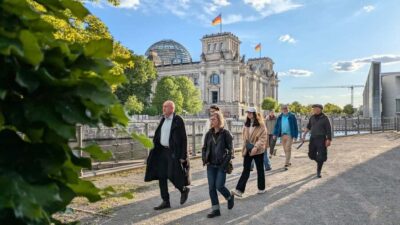 ★ 4.7Berlin City walk Government District and Places of DemocracyFrom $2948,467 reviews
 ★ 4.9Third Reich & Cold War Guided Walking TourFrom $238,378 reviews
 ★ 4.9Discover Berlin Walking TourFrom $235,998 reviews
 ★ 5.0Berlin’s Best: 2 Hour Walking Tour Third Reich and the Cold WarFrom $245,486 reviews
 ★ 4.8Hidden Backyards Guided Walking TourFrom $235,360 reviews
 ★ 5.0Third Reich Berlin: Hitler and WWII Walking TourFrom $243,301 reviews
 ★ 4.9Third Reich, Hitler, and WWII Walking TourFrom $191,757 reviews
 ★ 4.6Alternative Berlin Walking TourFrom $291,204 reviews
Browse the lists this tour appears in