
REVIEW · THIRD REICH & WWII HISTORY
Berlin: History of the Third Reich Guided Walking Tour
Nazis were not born overnight. This walk shows how power was built.
I like that the tour is short at 2 hours, so you get a focused, structured story without turning it into an all-day slog. I also like that you see still-standing architecture tied to the regime, not just distant plaques.
The biggest consideration is that the subject is dark and emotional. You’ll be standing at memorials and at places linked to terror and mass death, so it helps to be mentally ready, wear comfortable shoes, and expect serious moments.
In This Review
- Key things I’d plan around
- Starting at Brandenburg Gate: getting oriented fast
- The route in real life: how a 2-hour story stays coherent
- Luftwaffe headquarters: Third Reich architecture that survived bombing
- Goebbels’ propaganda ministry: where public life was managed
- SS and Gestapo headquarters on Prinz-Albrecht-Straße
- Soviet memorial: standing where liberation cost everything
- The Führer bunker site: where the war ended
- Price and value: is $30 a fair deal?
- Who should book this tour (and who may want a different pace)
- Practical tips: how to get the most out of the walk
- Should you book this Berlin Third Reich walking tour?
- FAQ
- How long is the Berlin History of the Third Reich guided walking tour?
- Where do I meet the guide?
- Is the tour conducted in English?
- Do I need transportation tickets?
- What should I bring?
- Is it wheelchair accessible and are children allowed?
Key things I’d plan around
- Intact Third Reich architecture: you visit the Luftwaffe Air Force headquarters, including Hermann Goering’s surviving complex
- Propaganda in the open: Goebbels’ former nerve center shows how the regime managed public life
- SS/Gestapo sites on Prinz-Albrecht-Straße: this area connects Nazi power, fear, and even a stretch of the Berlin Wall
- A concrete sense of loss: the Soviet Memorial marks the 80,000 soldiers who died liberating the city
- Hitler’s end-point: you stand above the former Führer bunker area where Nazi Germany collapsed
- Guides who can keep it moving: many guides, including Dani, Marcel, Hannah, Elizabeth, India, and Theo, are praised for storytelling pace and clarity
More walks through Berlin's wartime history
- Berlin: Third Reich & Cold War Guided Walking Tour★ 4.9 · 8,378 reviews
- Berlin’s Best: 2 Hour Walking Tour Third Reich and the Cold War★ 5.0 · 5,486 reviews
- Third Reich Berlin: Hitler and WWII Walking Tour★ 5.0 · 3,301 reviews
- Berlin: Third Reich, Hitler, and WWII Walking Tour★ 4.9 · 1,757 reviews
Starting at Brandenburg Gate: getting oriented fast
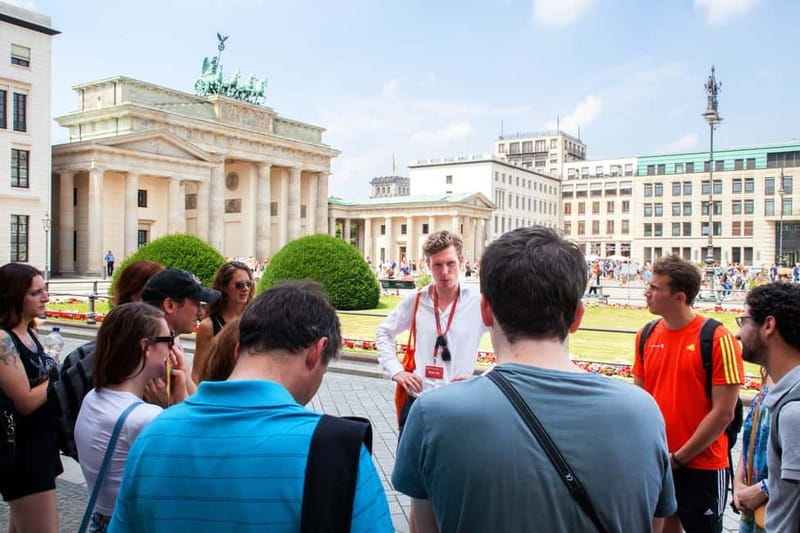
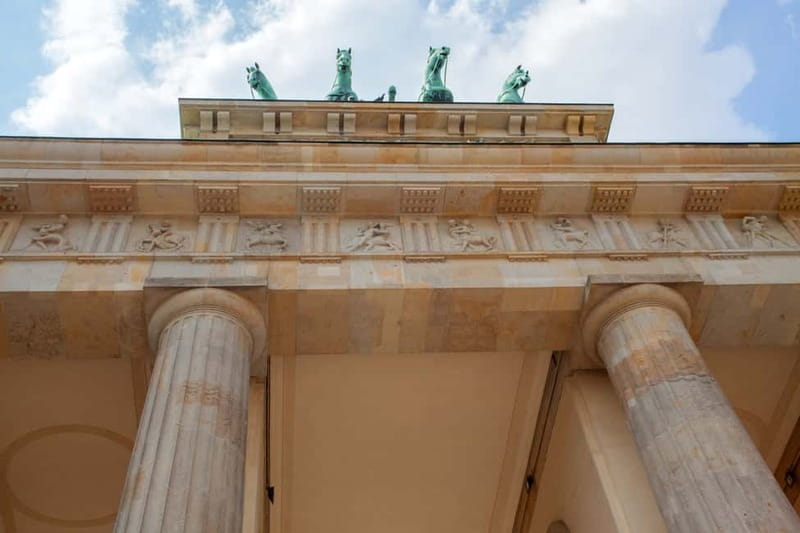
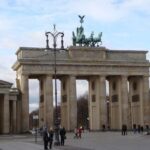
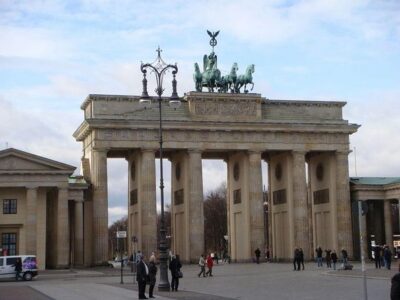
You meet the guide in front of Starbucks Café, near Berlin’s Brandenburg Gate. Look for the operator’s team wearing red t-shirts and holding red umbrellas. It’s an easy start point, and it gets you quickly into the walk instead of spending your time hunting for the group.
The tour is wheelchair accessible, and it’s built as a walking experience. That means you’ll want solid footwear—Berlin sidewalks can feel longer than you expect once you’re paying attention to history at every stop.
One more practical note: you’ll need an AB transport ticket for this tour. The tour runs for 2 hours, and you’ll likely move between several sites where timing matters, so don’t treat the transport ticket as optional. And there is a break partway through the walk, which helps when the material turns heavy.
The route in real life: how a 2-hour story stays coherent
This is not a “checklist” tour where you pass by plaques and move on. The guide threads a timeline: how Nazi power rose, how it was maintained, and how it ended. Because you’re walking in a small window of time, the structure matters.
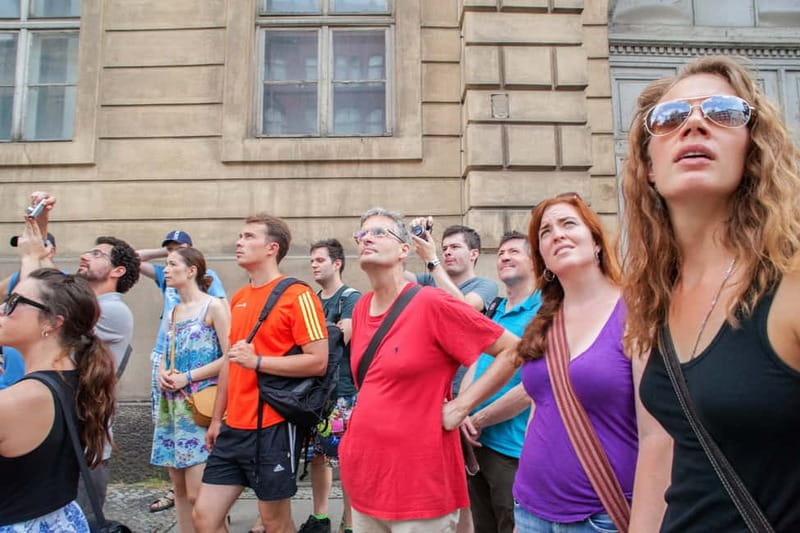
Expect the guide to keep you moving while still stopping at the right moments to explain what you’re looking at. Many guides have been noted for being patient with questions, so if something feels confusing—like what a specific building role was—you should ask. The group size can vary, but the overall feel is designed around keeping the story understandable.
And since the tour is only 2 hours, you’ll get the best value if you arrive with at least a basic sense of the major players: Hitler, Goebbels, Goering, and the SS/Gestapo. The guide will provide the context either way, but a little background helps you connect the dots faster.
Luftwaffe headquarters: Third Reich architecture that survived bombing
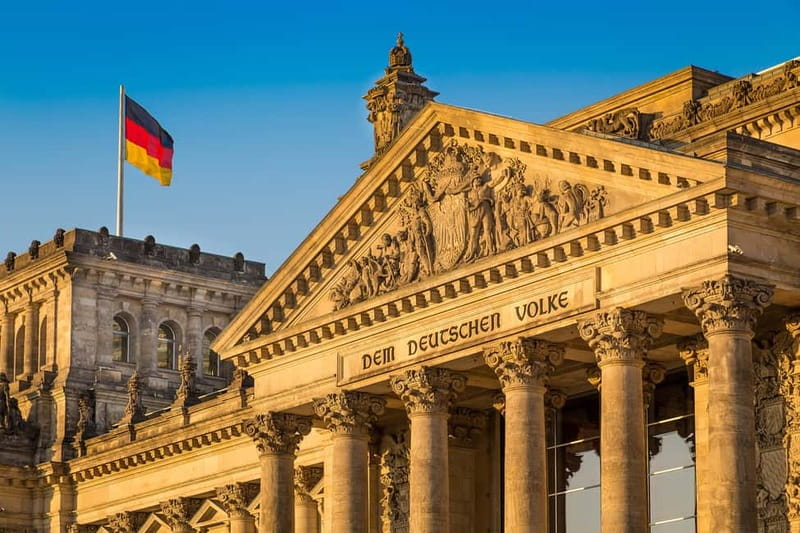
The first big stop is the Luftwaffe Air Force headquarters. This is one of those places that makes history feel physical because parts of the complex are still there. The tour highlights its connection to Hermann Goering, and it explains why this particular building matters beyond being old.
You’ll learn that the massive base survived allied bombing and that its architecture remains one of the best examples of Third Reich construction. That survival changes how you experience the site. Instead of imagining how the system might have looked, you see something that truly functioned as a command setting.
What I like about this stop for practical sightseeing: even if you’ve never studied architecture, you can still read it. It has scale. It has purpose. The guide helps you translate those visual cues into what power looked like in stone and concrete—command, control, and a sense that the regime meant business.
Potential drawback: because the building is impressive and the subject matter is heavy, you’ll want the guide’s pacing to land. If your mind tends to wander when you’re staring at big structures, focus on what the guide says about what decisions were made here and why the building was built that way.
Goebbels’ propaganda ministry: where public life was managed
Next comes Josef Goebbels’ former propaganda ministry. Here you shift from military power to information power, and that’s a key part of understanding the Nazi rise.
You’re told that before the war it functioned as the Berlin Press Office. Then it was rapidly converted into the nerve center of the Nazi propaganda machine. The point is not just that propaganda existed—it’s how the regime used institutions, offices, and routines to control what people saw, heard, and believed.
This stop is valuable because it shows how power doesn’t only rely on force. It relies on messaging systems. When a regime controls narratives, it shapes what citizens think is normal, what they fear, and what they accept.
If you like tours that connect buildings to human behavior, you’ll appreciate this one. It forces you to think about propaganda as a working machine, not a vague idea. And that carries beyond WWII, because the lesson is about how societies can be steered when communication becomes a weapon.
More of Berlin on foot


SS and Gestapo headquarters on Prinz-Albrecht-Straße
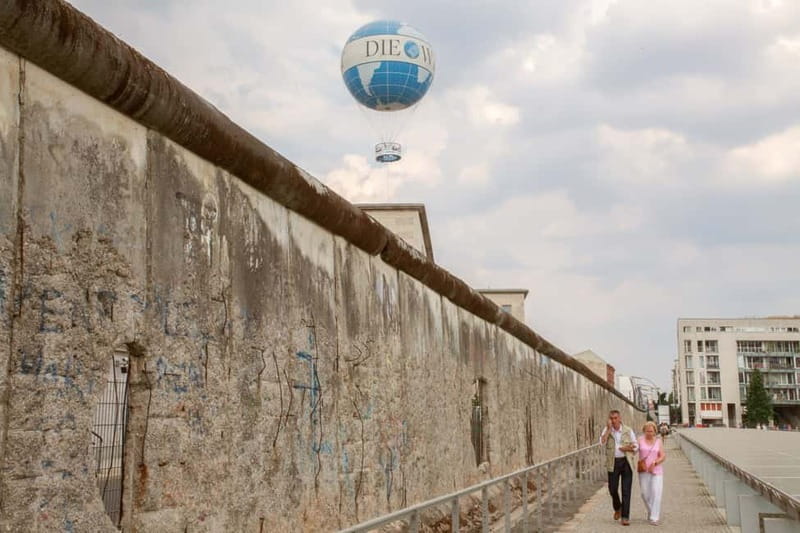
The tour then heads toward one of the most feared addresses in Nazi Germany: the SS and Gestapo headquarters. You’ll be in an area tied to terror and political persecution, and the guide’s job is to keep that context clear without turning it into spectacle.
Old Prinz-Albrecht-Straße is also home to one of the only remaining stretches of the Berlin Wall. That detail is more than a side note. It gives you a direct visual reminder that Berlin’s history didn’t end with WWII. The city kept reinventing itself through walls, boundaries, and political control.
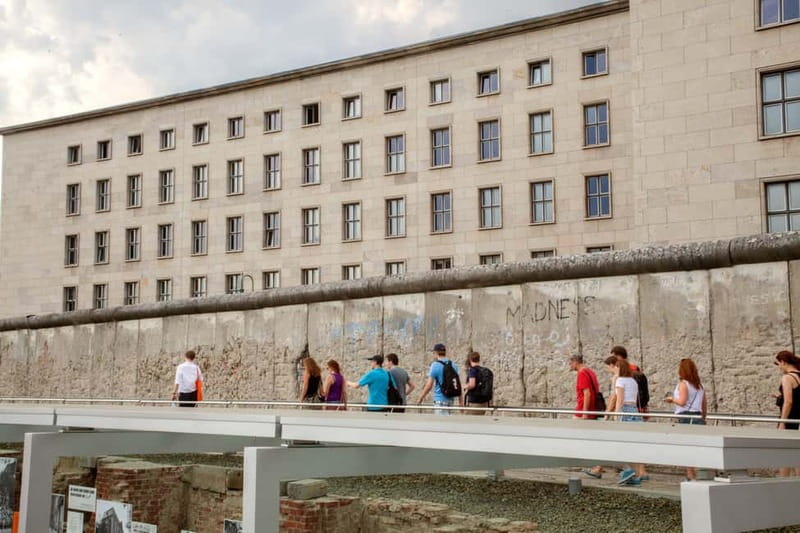
A strong part of this stop is going into the basement remains of the two buildings. Those spaces have been converted into an exhibition that documents the Nazis’ rise to power. In other words, you’re not only seeing the exterior of a feared institution—you’re also walking through a curated space that helps connect facts to place.
Possible consideration: this is the kind of stop where it’s easy to feel overwhelmed. If you start to get numb, lean on the guide’s explanations. Ask follow-up questions about the timeline or the meaning of specific rooms or materials. The goal is understanding, not just looking.
Soviet memorial: standing where liberation cost everything
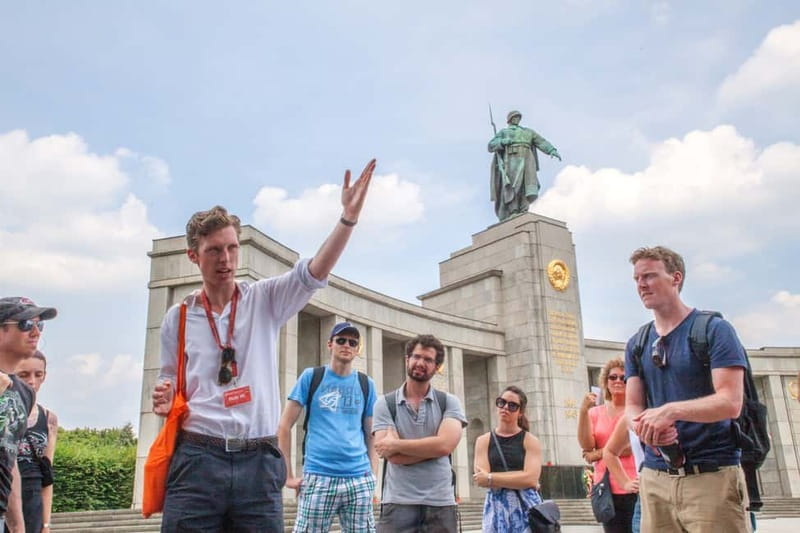
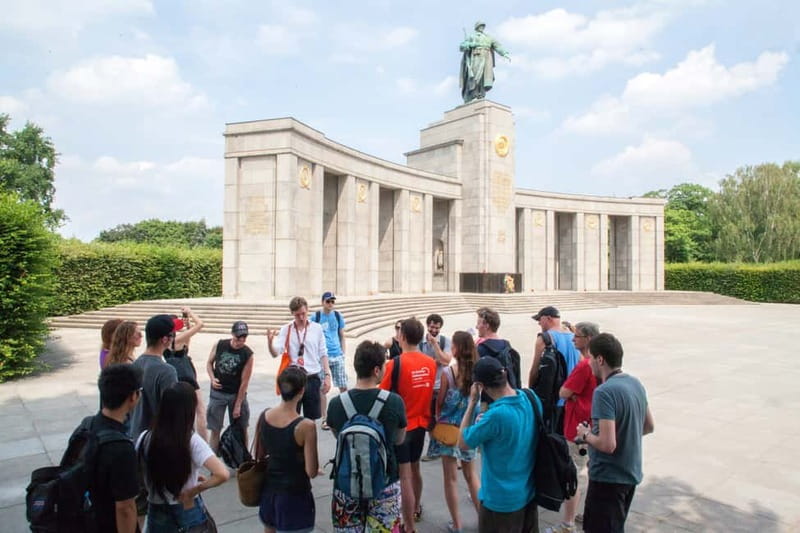
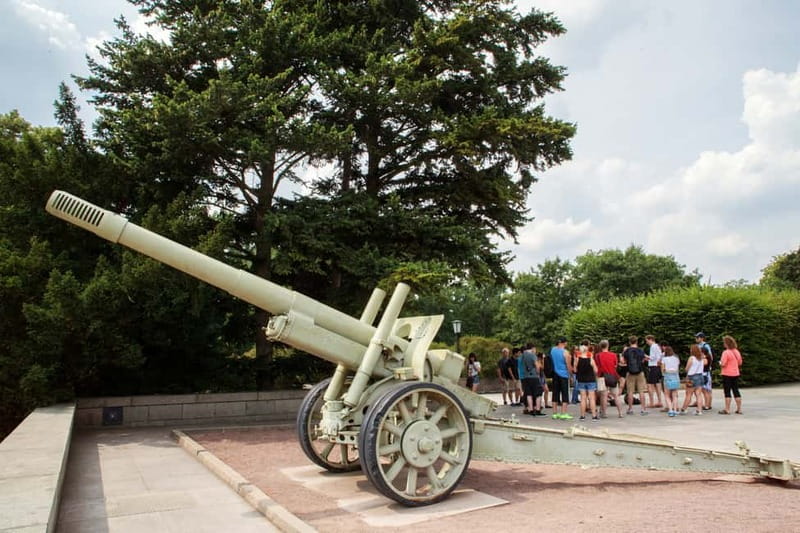
After the darker “how the regime worked” stops, you shift to remembrance and cost. You visit a Soviet Memorial in Berlin dedicated to the 80,000 soldiers who lost their lives liberating the city.
You’ll see 2 artillery pieces and 2 tanks positioned as silent guard. That’s a striking choice for a memorial because it’s not abstract. It tells you: war didn’t just happen to strangers far away; it arrived, it fought, and it killed.
This stop matters because it widens the story. A Nazi-focused tour can leave you with the impression that the only tragedy was on one side. Here, the memorial anchors the experience in the human cost of liberation—again, with scale you can visually grasp.
I also like that the guide frames this in a way that supports reflection rather than blame-riddled conclusions. You can mourn the deaths without losing the historical purpose of understanding what happened and why the end came when it did.
The Führer bunker site: where the war ended
The final major theme lands at the site of the former so-called Führer bunker, where Nazi Germany ended. You stand above what used to be Hitler’s bunker and where he ended his life as the Russian army closed in.
This stop can feel surreal. You’re in the city, walking normal sidewalks, and then the guide connects the location to the final collapse of an evil regime. That mismatch is exactly why guided interpretation helps. Without it, the area would just read as another piece of Berlin.
What’s useful here is the way the tour ties the ending back to the earlier steps. Once you’ve seen how propaganda shaped public life and how terror enforced control, the collapse is more than just a date. It becomes the consequence of a system built to destroy people and then continue through fear.
Possible drawback: because you’re near the end of the story, you might feel emotionally drained. Plan to take the break seriously, and if you need a moment, step aside when the guide pauses for questions.
Price and value: is $30 a fair deal?
At $30 per person for a 2-hour guided walking tour, the value depends on what you want from Berlin.
If your goal is to see only a few notable exteriors and take photos, you can probably DIY a route. But you’d miss the “why” behind each stop—the explanation that turns buildings into evidence. The tour includes a live guide and the walking structure, so you’re paying for guided interpretation of multiple high-impact sites in a short window.
Also, note what’s not included. Food and drinks aren’t covered, entrance fees aren’t listed as included, and you need transport tickets (like the AB ticket) for the tour. So the true cost is closer to $30 plus your transit and any on-the-go needs. Still, for a history-heavy outing that packs major locations into two hours, it can be a strong use of time.
Where it feels like excellent value is the guide quality. The guides associated with this walk—people like Dani, Hannah, Elizabeth, India, Theo, Marcel, and Mark—are repeatedly described as friendly, patient, funny at the right moments, and able to make a hard story understandable without watering it down.
Who should book this tour (and who may want a different pace)
This is a great pick if you:
- want a structured timeline of Nazi rise to power and the regime’s end
- enjoy walking tours where the guide explains what you’re seeing, not just where you are
- want Berlin’s WWII story tied to real sites, including surviving architecture
- like memorial visits that give scale to loss, including the Soviet Memorial
You might consider another tour if:
- you’re looking for something light and casual
- you prefer museums over walking history, since some sections involve emotionally difficult material
- you’re not comfortable with serious themes that focus on SS, Gestapo, propaganda, and mass death
That said, the tour isn’t presented as shock value. It’s a guided history walk meant to help you understand how the system operated and why it collapsed.
Practical tips: how to get the most out of the walk
Bring comfortable shoes. You’re on your feet for the full walking experience, and you’ll cover several stops close enough to move efficiently but long enough to feel in your legs.
Wear a weather-ready layer. Berlin can be cold and wet, and the tour includes outdoor walking between sites. The existence of a break partway through helps, but you don’t want to rely on that for comfort—just use it as a mental reset.
If you tend to ask questions, do it. Many guides have been praised for handling question-heavy groups and keeping the explanation clear. Use the break to jot down anything you want clarified later, especially about what each building role meant.
Finally, if you’re visiting Berlin alongside other WWII or Cold War sites, this tour works well as a “structure” stop. It connects propaganda, terror institutions, military command locations, and the ending—so later museum visits make more sense.
Should you book this Berlin Third Reich walking tour?
I think you should book it if you want a tight, guided way to understand Nazi Germany through the places where it left traces. The combination of surviving Third Reich architecture (like the Luftwaffe headquarters), key propaganda and terror sites (Goebbels’ ministry and the SS/Gestapo area), and remembrance (the Soviet Memorial for 80,000 soldiers) makes the tour more than a history lecture on a street corner.
Skip it if you want something upbeat or you’re not ready for the emotional weight that comes with memorials and sites tied to persecution. But if you can handle a serious, well-told timeline, this is one of the more efficient ways to grasp how the regime worked—and how it ended.
FAQ
How long is the Berlin History of the Third Reich guided walking tour?
The tour lasts 2 hours.
Where do I meet the guide?
Meet your guide in front of Starbucks Café near Berlin’s Brandenburg Gate. Look for the local operator’s team wearing red t-shirts and holding red umbrellas.
Is the tour conducted in English?
Yes. The live guide speaks English.
Do I need transportation tickets?
Yes. You will need to purchase an AB transport ticket for this tour.
What should I bring?
Bring comfortable shoes, since it is a walking tour.
Is it wheelchair accessible and are children allowed?
The tour is wheelchair accessible. Children up to 13 can join for free, and the local partner may ask for valid ID.
More Tours in Berlin





More Tour Reviews in Berlin
Berlin's Wartime History

Round out your days in Berlin
Third Reich & WWII History, compared.
 ★ 4.9Third Reich & Cold War Guided Walking TourFrom $238,378 reviews
 ★ 5.0Berlin’s Best: 2 Hour Walking Tour Third Reich and the Cold WarFrom $245,486 reviews
 ★ 5.0Third Reich Berlin: Hitler and WWII Walking TourFrom $243,301 reviews
 ★ 4.9Third Reich, Hitler, and WWII Walking TourFrom $191,757 reviews
 ★ 5.0Berlin Third Reich Sites: Half-Day Walking TourFrom $21835 reviews
 ★ 4.8The Wall and Third Reich Guided Bike TourFrom $41578 reviews
 ★ 4.8Hitler’s Germany: Berlin During the Third Reich & WWIIFrom $23476 reviews
 ★ 5.0Private Walking Tour Berlin Third Reich Hitler and World War IIFrom $192360 reviews
Browse the lists this tour appears in